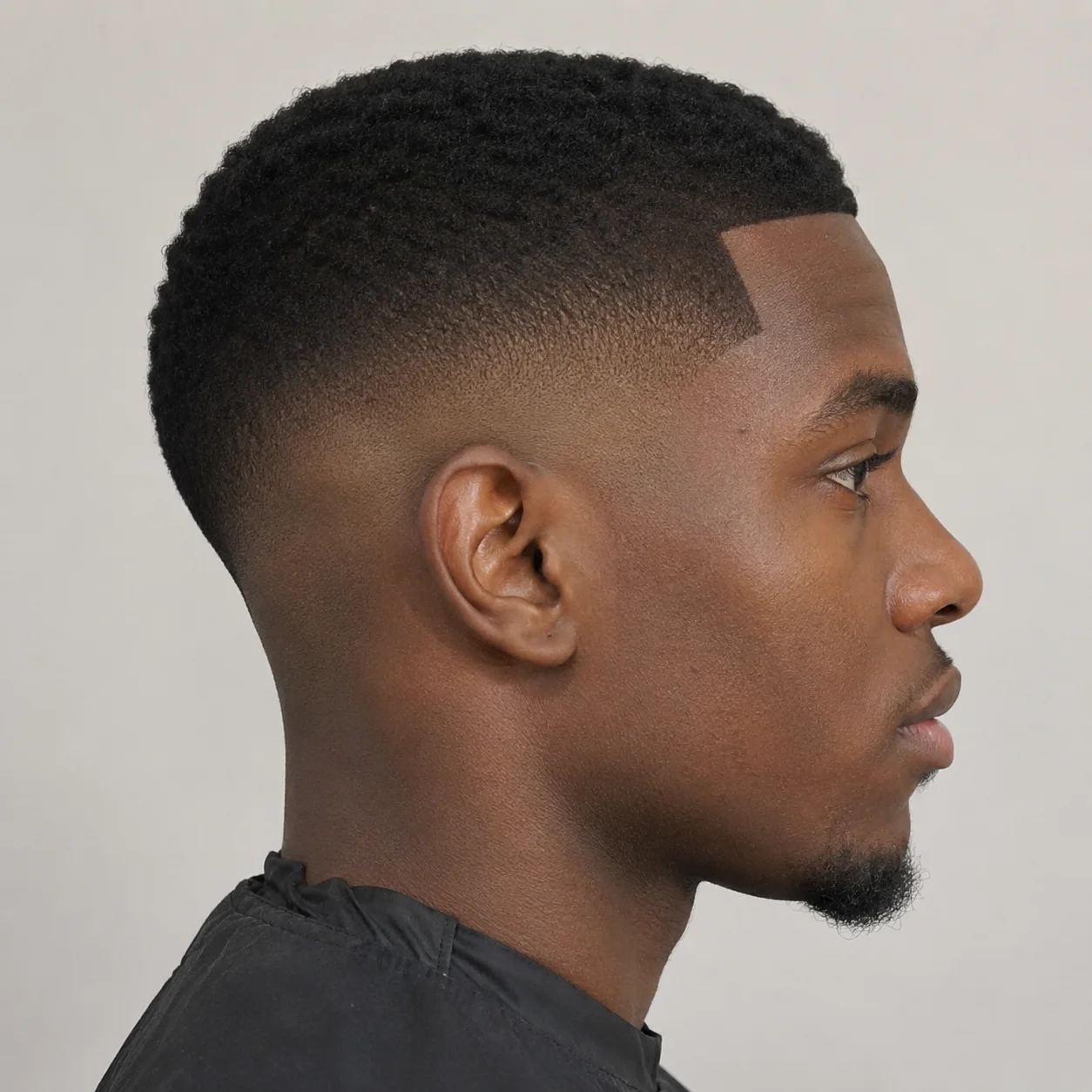
A low fade is a haircut where the sides and back blend from very short to longer, starting just above the ears and following the natural hairline around the back of the head. Because the shortest part sits low, most of the side hair keeps its length, so the cut looks clean and sharp without the high contrast of a mid or high fade.
It is the most forgiving fade: it suits most face shapes, works on nearly every hair type, and is usually acceptable in conservative workplaces. If you are getting your first fade, this is the safest place to start.
Low fade at a glance
| Where the fade starts | Just above the top of the ear, following the hairline around the back |
| Best for | Oval, square and oblong faces; straight, wavy, curly and coily hair; first-time fades |
| Hair density | Works on thick to medium density; also flatters thinner hair because the sides stay fuller |
| Length on top | Anything from a buzz to 4+ inches |
| Maintenance | Barber visit roughly every 3 to 4 weeks to keep the blend clean |
| Styling time | Depends on the top; the faded sides need no styling |
| Styling difficulty | Easy |
| Workplace friendly | Yes, one of the most conservative fades |
Where a low fade starts (and how it differs from mid and high)
The height of a fade is simply where the shortest length begins. On a low fade that line sits about a finger-width above the ear and drops down toward the neck at the back. A mid fade starts higher, around the middle of the side of the head, and a high fade starts near the temple or where the head starts to curve toward the top.
Barbers do not all place these lines in exactly the same spot, which is why it helps to point to where you want the fade to start rather than relying on the name alone. For a side-by-side comparison, see low vs mid vs high fade.
Clipper guard numbers for a low fade
Guard numbers tell the barber how long to leave the hair. The common clipper guard lengths are:
| Guard | Hair length left |
|---|---|
| #0 (no guard) | Very close; the exact length depends on the clipper and its lever position |
| #1/2 | 1/16 inch |
| #1 | 1/8 inch |
| #2 | 1/4 inch |
| #3 | 3/8 inch |
| #4 | 1/2 inch |
A typical low fade goes from a short guard at the bottom (#0, #1/2 or #1) up to a longer guard where it meets the side hair (#2, #3 or #4). A low skin fade takes the bottom down to bare skin with a foil shaver or razor; a low taper fade only fades the sideburns and the neckline and leaves the rest of the sides longer. If you are unsure which of those two you want, read skin fade vs taper fade.
Popular low fade variations
Low skin fade
The bottom of the fade goes to the skin. It gives the sharpest look a low fade can have, but shows grow-out sooner, so plan on touch-ups every 2 to 3 weeks.
Low taper fade
Only the sideburn and neckline areas are faded. It is the most subtle option and grows out gracefully, which makes it a good choice for office settings. Our taper haircut guide covers the taper family in detail.
Low drop fade
The fade line curves down behind the ear toward the nape instead of running straight around the head. It follows the shape of the head and pairs well with waves and curls.
Low fade with a textured crop or French crop
A short, choppy top with a low fade underneath is one of the most requested combinations. See our textured crop guide for top-length options.
Low fade with a longer top
Quiffs, pompadours, side parts and slick backs all work over a low fade. Because the sides keep some weight, the overall shape stays balanced rather than top-heavy.
Low fade on curly and coily hair
A low fade tidies the sides while letting curls stay full on top. Our guide to haircuts for curly hair by curl type shows which top shapes suit each curl pattern.
Who a low fade suits
- Oval and oblong faces: keeping side length avoids making a long face look longer.
- Square faces: keeps the jawline strong without adding harsh contrast.
- Round faces: works, especially with some height on top. A mid fade can slim a round face a little more.
- Thinner or receding hair: fuller sides make the top look denser by comparison. See haircuts for receding hairlines.
- Anyone who wants a professional look: a low fade reads as neat rather than edgy.
Not sure about your face shape? Our haircuts by face shape guide walks you through it.
Who might prefer a different fade
- If you want a bold, high-contrast look, a mid or high fade will show more.
- If your face is very round and you want the sides to look slimmer, a mid fade usually does more.
- If you only want a clean neckline and sideburns, a simple taper may be all you need.
How to ask your barber for a low fade
Be specific about three things: where the fade starts, how short the bottom goes, and how much to take off the top. For example:
“I’d like a low fade that starts just above the ear and follows my hairline at the back. Take the bottom down to a #1 [or: to the skin], blend it up to a #3 on the sides. On top, just take half an inch off and keep it textured.”
Bring a reference photo taken from the side, and ask your barber to show you where they plan to start the fade before they cut. For more wording, see how to ask your barber for exactly what you want, or build a script with our barber instruction generator.
How long a low fade lasts
A low fade usually looks sharp for about 2 weeks and starts to lose its blend after 3 to 4 weeks, because hair grows roughly half an inch a month. A skin fade shows grow-out sooner than a fade that stops at a #1. Between visits, a quick neckline tidy at home can stretch the cut a few days, but leave the blend itself to your barber.
Styling products for common low fade tops
- Textured crop or messy top: matte paste or clay.
- Quiff or pompadour: a blow-dry with sea salt spray, then a medium-hold pomade or cream.
- Side part or slick back: water-based pomade for shine, or cream for a softer finish.
- Curls: a leave-in conditioner or curl cream rather than a strong-hold product.
Common low fade mistakes
- Not saying where the fade starts. “Low fade” means slightly different heights to different barbers.
- Going to the skin without planning upkeep. Skin fades need more frequent visits.
- Leaving too much bulk on top with thick hair. Ask for the top to be thinned or texturized so it doesn’t overhang the faded sides.
- Waiting too long between cuts. After about a month the blend disappears and the cut just looks grown out.
Frequently asked questions
Is a low fade good for a first fade?
Yes. It is the most subtle fade and the easiest to grow out if you decide it is not for you.
What is the difference between a low fade and a low taper?
A low fade blends the whole back and sides from short to long starting above the ear. A low taper only shortens the sideburns and neckline, leaving the rest of the sides longer.
Can I get a low fade with long hair on top?
Yes. A low fade keeps enough weight on the sides that a longer top still looks balanced.
How often should I get a low fade touched up?
Every 3 to 4 weeks for most people, or every 2 to 3 weeks for a low skin fade.
Which fade should I choose?
If you are torn between low, mid and high, try our fade selector, or browse more styles in our fade haircuts guide.