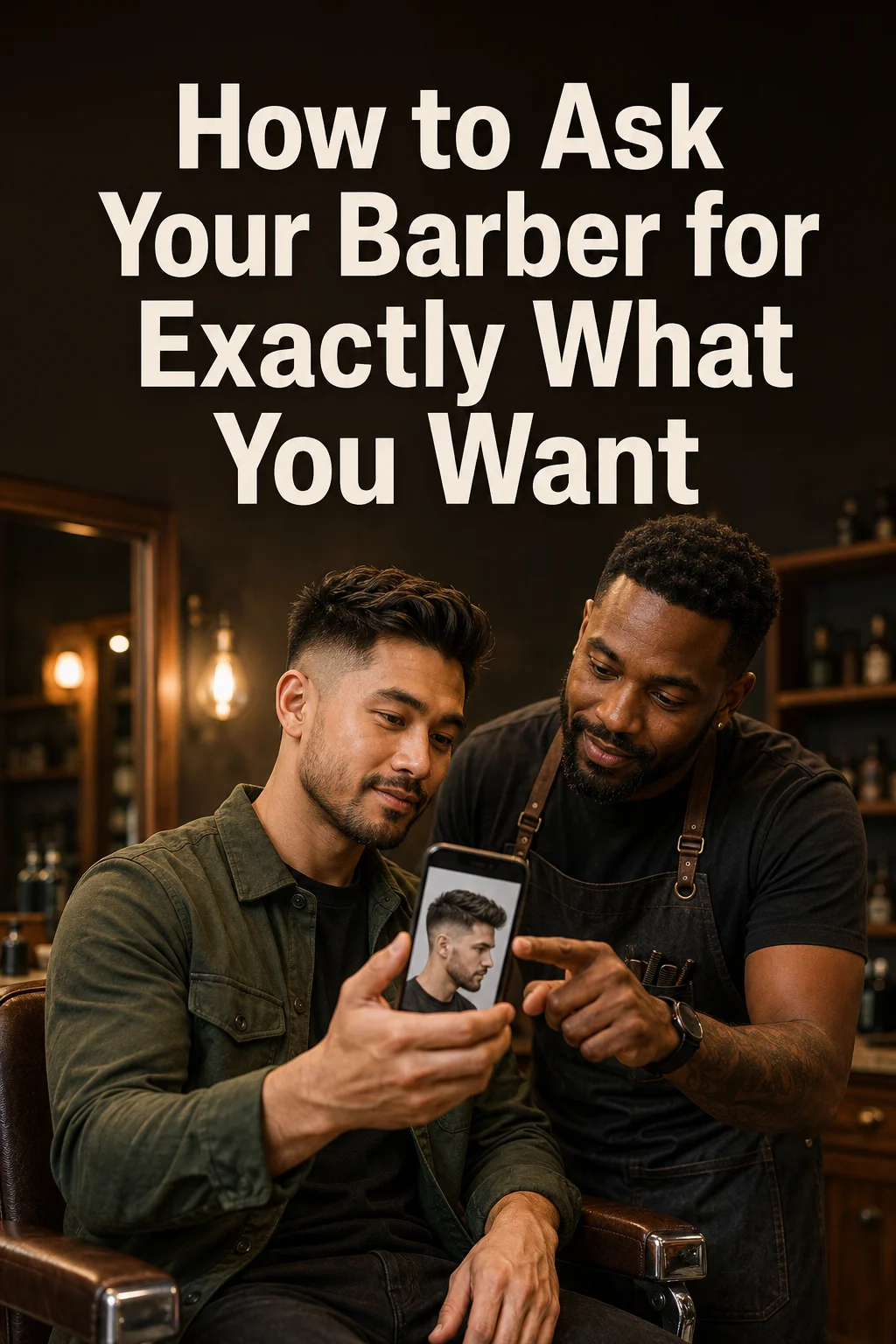
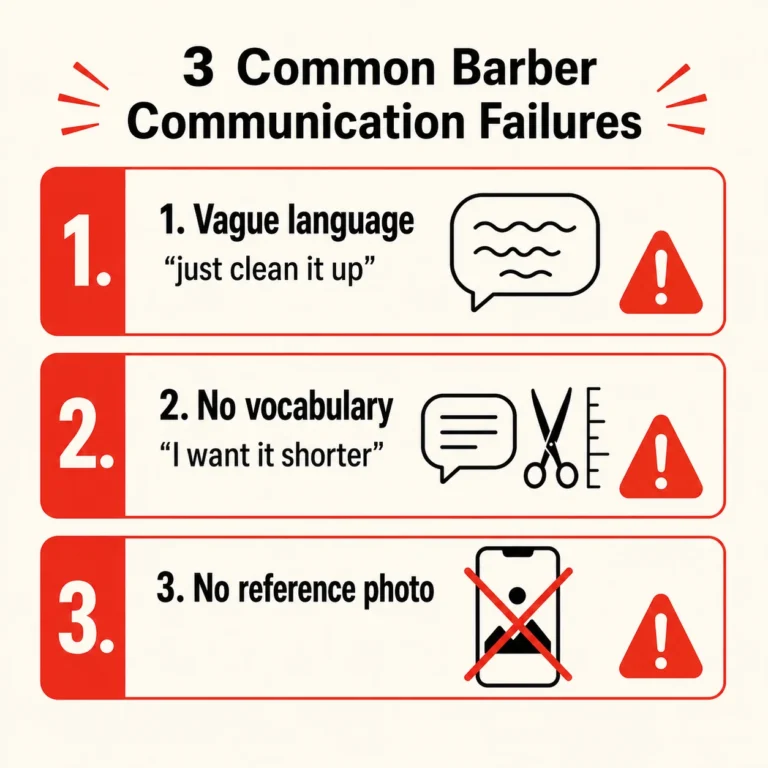
You’ve sat in that chair. You described what you wanted. The barber nodded. And then — somewhere between “a little off the sides” and “just clean it up” — something went wrong.
You’re not alone. Miscommunication between client and barber is one of the most universal experiences in men’s grooming. And almost every time it happens, it’s not because the barber is bad at their job. It’s because the language of haircuts is specific — and most men were never taught it.
The good news: it’s not complicated. A handful of key terms and a clear communication framework are all it takes to walk out of every barbershop visit looking exactly how you envisioned.
This guide gives you the terminology, a simple framework, the questions to ask and the mistakes to avoid.
Quick answer: what to ask for at the barbers. Tell your barber three things:
- The sides: fade or taper, how high, and how short at the bottom. For example, “low taper, number 2 at the bottom”.
- The top: how much length to leave, in inches or a clipper number. For example, “leave 2 inches on top”.
- The finish: the neckline (tapered, rounded or squared) and whether you want it textured or smooth.
Show a photo if you have one. In the UK, barbers often say grade instead of number: a grade 2 is the same as a number 2. Not sure what to say? Our barber instruction generator builds the sentence for you.
The Essential Barber Vocabulary Every Man Needs
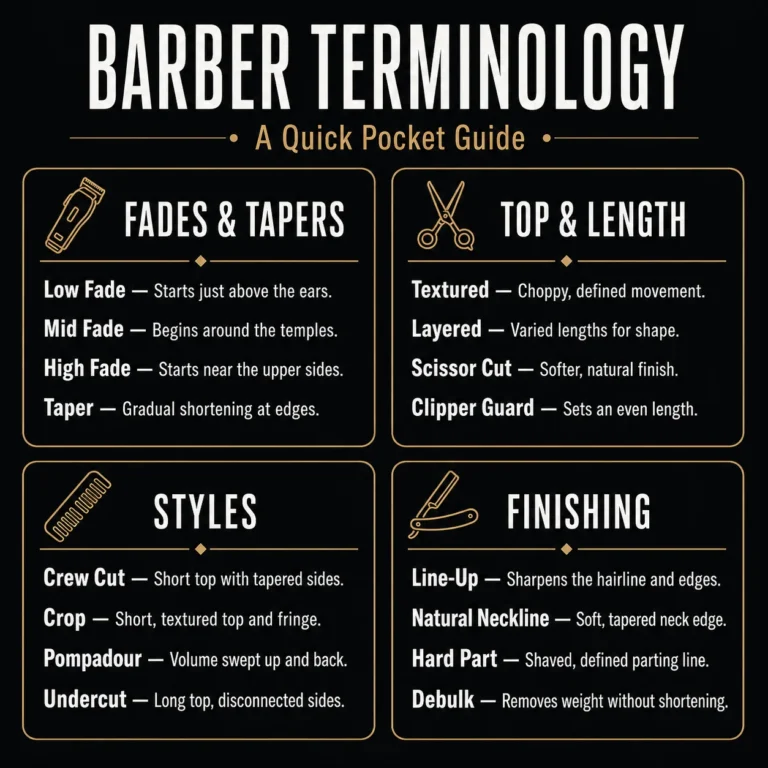
Fade & Taper Terms
Fade — hair that blends gradually from longer on top to shorter (often skin-level) on the sides and back.
Taper — similar to a fade but more subtle; hair gradually shortens without going all the way to skin. More conservative and natural-looking.
Skin fade / bald fade — the sides blend completely down to bare skin.
Low fade — the fade begins just above the ears and neckline. Subtle, conservative.
Mid fade — the fade begins around the temple level. Balanced and versatile.
High fade — the fade begins above the temples, near the top of the head. Bold, high-contrast.
Drop fade — the fade line curves downward behind the ear before rising back up at the neckline.
Burst fade — the fade arcs in a semicircle around the ear, creating a rounded silhouette.
Temple fade / Brooklyn fade — a targeted fade specifically around the temple area only.
Top & Length Terms
Clipper guard numbers — the most precise way to specify length on the sides:
- Number 0 / 0.5 = skin or near-skin (1–1.5mm)
- Number 1 = very short (3mm)
- Number 2 = short (6mm)
- Number 3 = medium-short (10mm)
- Number 4 = medium (13mm)
- Number 5–8 = medium to longer lengths
Inches — for the top of the head, give your desired length in inches. “Leave 2 inches on top” is far more precise than “leave it long.”
Textured / point cut — scissors technique that creates separation and texture in the hair rather than a blunt, flat cut. Essential vocabulary for men with thick hair.
Scissor cut — cutting entirely with scissors rather than clippers. Produces a softer, more natural result — often better for textured or curly hair on top.
Layered — hair cut at different lengths throughout to create movement, volume, and texture.
Thinned out — using thinning scissors to remove internal bulk without changing the overall length. Critical for thick hair.
Style Terms
Crew cut — short, even length on top (half to one inch) tapering down the sides.
Textured crop / French crop — short hair on top with a horizontal fringe and textured finish, usually with a fade.
Quiff — hair on top swept upward and slightly forward. Can be tight and structured or loose and textured.
Pompadour — voluminous style swept back from the forehead. Requires length and product.
Comb over — hair on top combed to one side. Modern versions are short and natural; not the old coverage style.
Slick back — hair combed straight back from the forehead with product.
Side part — hair parted to one side, combed in opposite directions from the part.
Undercut — hair on top disconnected from the shaved or very short sides with no blending.
Finishing Terms
Line up / edge up / shape up — a razor-sharp geometric edge cut along the natural hairline (forehead, temples, and around the ears). Makes the hairline look precise and freshly cut.
Hard part — a shaved line parted into the hair, creating a precise, visible parting.
Neckline options:
- Tapered neckline — hair at the back of the neck blends gradually into the skin. Looks natural as it grows out.
- Blocked / square neckline — a hard, straight line cut across the back of the neck. Looks very sharp immediately after the cut.
- Rounded neckline — a curved line at the back of the neck. Natural-looking, softens the back of the head.
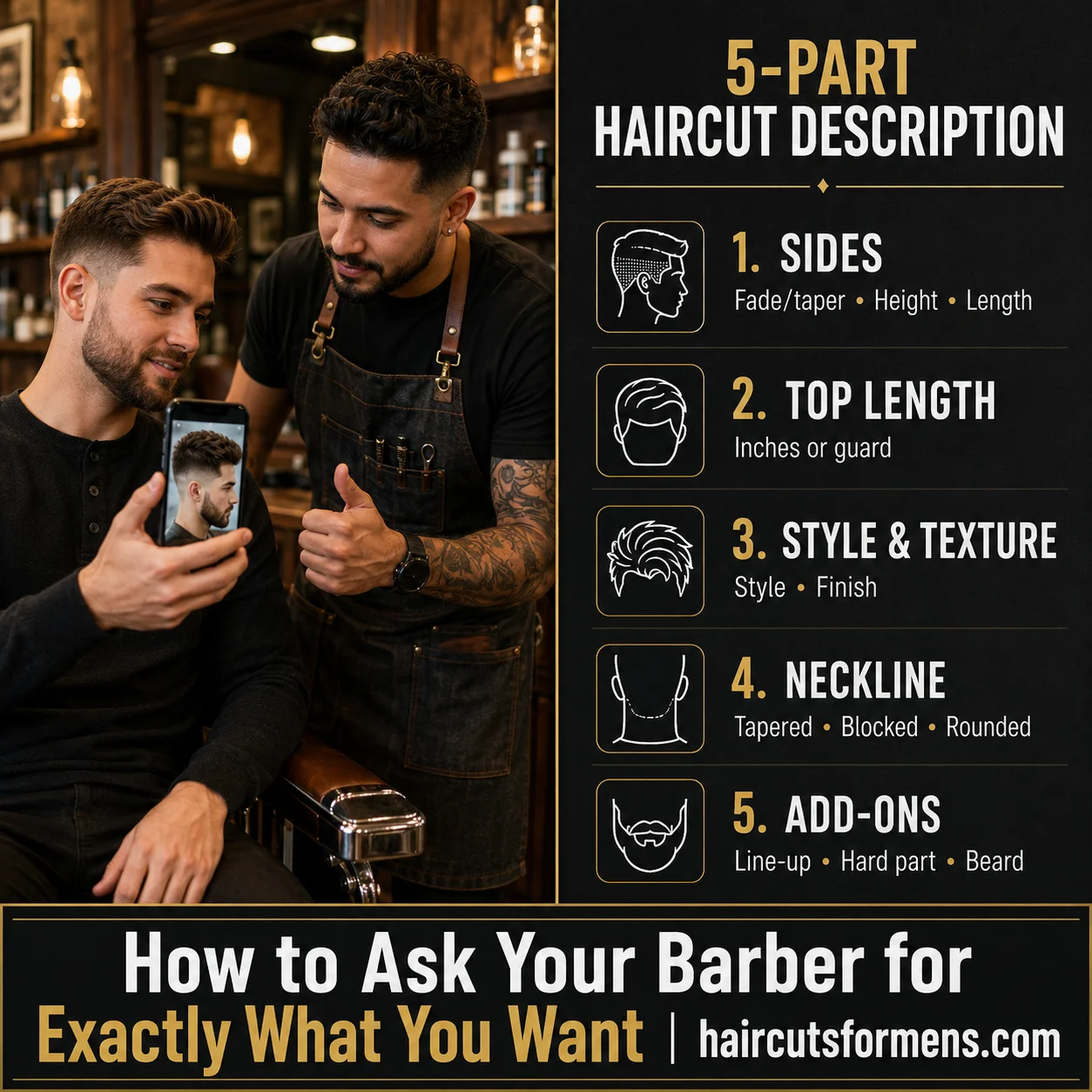
The 5-Part Framework for Describing Any Haircut
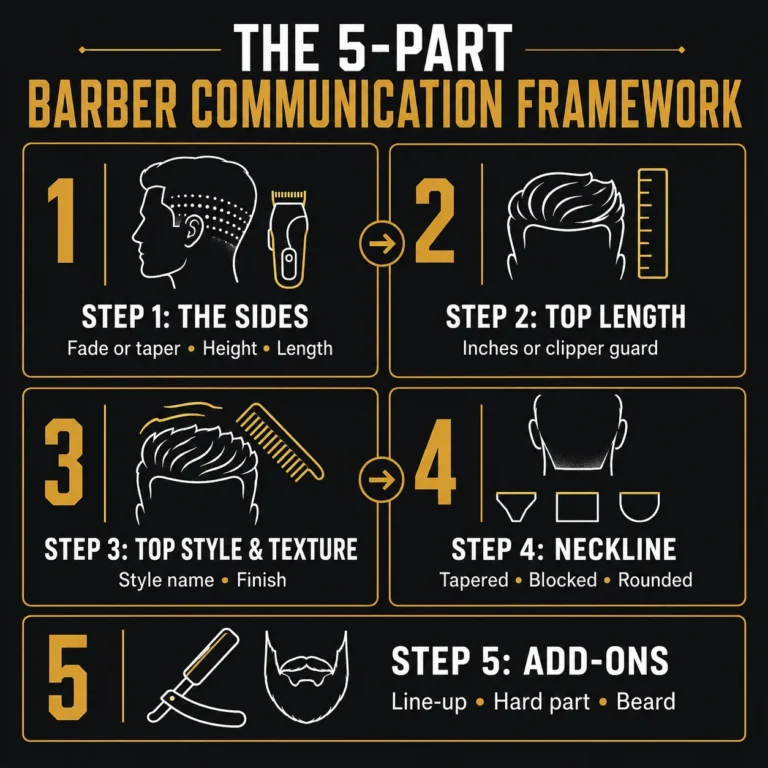
With vocabulary in hand, here’s the framework. Every haircut description needs these five elements — cover all five and your barber has everything they need.
Part 1: The Sides
This is the most important decision and needs the most specificity.
Decide:
- Fade or taper?
- What height — low, mid, or high?
- How short at the bottom — skin, number 1, number 2?
Example: “Mid skin fade” / “Low taper, number 2 at the shortest” / “High fade down to skin”
Part 2: The Top — Length
Give a specific measurement in inches, or reference a guard number if it’s short.
Example: “Leave 2 inches on top” / “Number 3 on top” / “3.5 inches — I’m growing it out”
Part 3: The Top — Style & Texture
What do you want the top to look like? Name the style if you know it, or describe the finish.
Example: “Textured — I want it to look messy” / “Comb over to the left” / “Slicked back” / “Just natural, no specific style”
Part 4: The Neckline
Tapered, blocked, or rounded? Most men skip this — don’t. It matters more than you think.
Example: “Tapered neckline please” / “Block the back”
Part 5: Any Add-Ons
Line up, hard part, beard fade, design?
Example: “And a line up on the hairline” / “Hard part on the left” / “Can you fade the beard in too?”
Putting it all together — a complete example:
“Can I get a mid skin fade — number 1 at the shortest — with 2 inches on top, textured and a bit messy. Tapered neckline please, and a line up on the hairline.”
That’s 35 words. Your barber now knows exactly what to do. No ambiguity, no assumptions.
The Single Most Powerful Tool: The Reference Photo
No verbal description, no matter how precise, is as clear as a well-chosen photo.
A reference photo gives your barber:
- The exact fade height you want
- The texture and finish you’re going for
- The proportions between top and sides
- A shared visual target that eliminates interpretation
How to choose the right reference photo:
- Match your hair type — showing a photo of a man with straight hair when you have thick curly hair sets unrealistic expectations. Find a reference on someone with similar hair to yours.
- Show multiple angles — a front-facing photo and a side profile together give the barber far more information than one angle alone.
- Be honest about your starting point — if your hair is very different from the reference, acknowledge it. “I know mine won’t look exactly like this but this is the direction I want.”
- Use recent photos — styles evolve. A photo from 2019 might reference a style that’s been updated significantly. Use 2025–2026 references.
Where to find good reference photos:
- This site (haircutsformens.com) — all posts include style photos with descriptions
- Instagram barbershop accounts — search by style name (e.g. #midfade, #edgarcut)
- Pinterest — search “[style name] men 2026”
- Google Images — search the specific style name
Save it before you go. Screenshot the photo to your camera roll so you’re not fumbling with a browser in the barber’s chair.
Questions to Ask Your Barber (Before They Start)
Most men sit down, describe what they want, and wait for the result. The best barbershop clients go one step further — they ask questions. Here are the most useful ones:
“What length do you recommend for my face shape?” A great barber will immediately think about your face shape when cutting. Inviting that conversation gets you better results and shows you understand the nuance involved.
“How much shrinkage should I expect?” Critical for curly and coily hair — but useful for any hair type. Knowing that your 3 wet inches will dry to 2 helps you calibrate the final result.
“Can I see the length before you fade the sides?” Ask this if you’re unsure about the top length. A good barber will cut the top first and show you before committing to the fade — easier to take more off than to put it back.
“What do you recommend for my hair type?” If you’re trying something new, your barber’s professional opinion on what works for your specific hair texture is genuinely valuable. They see hundreds of heads a week.
“How often should I come back to maintain this?” Different styles have very different maintenance requirements. Knowing upfront — “you’ll want to come back in 2–3 weeks for this fade” — helps you plan and budget.
How to Give Feedback During the Cut
Giving feedback mid-cut can feel awkward — but it’s completely normal and any professional barber expects it. The key is to be specific and constructive, not vague or apologetic.
Instead of: “Can you make it a bit shorter?” Say: “Can you take another half inch off the top?”
Instead of: “The sides feel a bit long.” Say: “Can you take the fade a bit higher — I’d like it to start above the temples.”
Instead of: “I’m not sure about the fringe.” Say: “Can we trim the fringe a little shorter — I’d like it to sit just above my eyebrows rather than at them.”
The barber is not going to be offended. They want you to be happy with the result — specific feedback makes that easier, not harder.
What to Do if You Get a Bad Haircut
It happens. Even with perfect communication, sometimes the result isn’t what you expected. Here’s how to handle it:
Say something before you leave. This is the most important step. Most barbers will fix it immediately if you mention it calmly in the chair. Leaving and complaining later gives you fewer options.
Be specific about what’s wrong. “It’s a bit shorter than I wanted on top” is actionable. “I just don’t like it” is not.
Take a photo for next time. If the haircut ends up being one you love, photograph it from multiple angles before it grows out. Now you have your own perfect reference for the next visit.
Find a regular barber. The single biggest factor in consistently good haircuts is having a barber who knows your hair, your preferences, and your face. Building that relationship takes 2–3 visits — after that, you barely need to describe anything at all.
The Complete Barber Script Cheat Sheet
Save this. Screenshot it. Use it.
| Situation | What to Say |
|---|---|
| Classic short back and sides | “Low taper, number 2 on the sides, number 4 on top — natural finish, tapered neckline.” |
| Skin fade with textured top | “Mid skin fade, 2 inches on top textured and messy, line up on the hairline.” |
| Conservative office cut | “Low taper, 1.5 inches on top, side part to the left, tapered neckline — nothing too short.” |
| Trendy crop | “High skin fade, inch and a half on top, textured French crop with a heavy fringe.” |
| Growing it out | “Just a shape-up — no length off the top. Low taper to clean up the sides, tapered neckline.” |
| Curly hair style | “Leave 3 inches of curl on top, mid skin fade — please cut it dry so you can see the pattern.” |
| First visit to a new barber | “I’d like [style] — I’ve brought a reference photo. My hair is [type] and I usually find [known issue with your hair]. What do you recommend?” |
Frequently Asked Questions
How do I tell my barber what I want without knowing the terminology? Bring a photo — it eliminates the need for precise vocabulary entirely. If you don’t have a photo, describe the end result rather than the process: “I want it to look sharp and professional, short on the sides, with enough length on top to style it.” Then let the barber suggest the specific technique.
What should I tell my barber for a first visit? Tell them your hair type, any known challenges with your hair (grows too puffy, goes flat quickly, receding at the temples), the approximate length you want, and bring a reference photo. Also mention your lifestyle — how much time you spend styling, how formal your work environment is.
How do I ask for a fade without knowing which type? The simplest approach: say “I want a fade” and describe how dramatic you want it — “quite dramatic” (high fade), “balanced” (mid fade), or “subtle” (low taper). You can also hold your finger to your head at the height you want the fade to begin.
Is it rude to correct your barber mid-cut? Not at all — it’s professional and helpful. Barbers prefer specific, constructive feedback mid-cut over silent unhappiness at the end. Say it early, say it specifically, and say it politely.
How do I describe a hairstyle I saw online? Save the photo and show it directly. If you want to describe it verbally: name the top style (quiff, crop, slick back), the side treatment (low/mid/high fade or taper), and the overall feel (sharp and clean, messy and textured, natural and relaxed).
What if my barber doesn’t speak the same language? Photos are universal. A clear reference photo works in any language. The barber can ask follow-up questions by pointing and using hand gestures for length — it’s more effective than you’d expect.
Final Thoughts
The barbershop is one of the few places where a 20-minute visit can meaningfully change how you feel about yourself. A great haircut builds confidence. A bad one — from a communication failure that could have been avoided — is genuinely frustrating.
You now have everything you need to make every barbershop visit a great one: the vocabulary, the framework, the photo strategy, and the questions to ask. Use them.
Walk in prepared. Walk out looking exactly how you wanted.