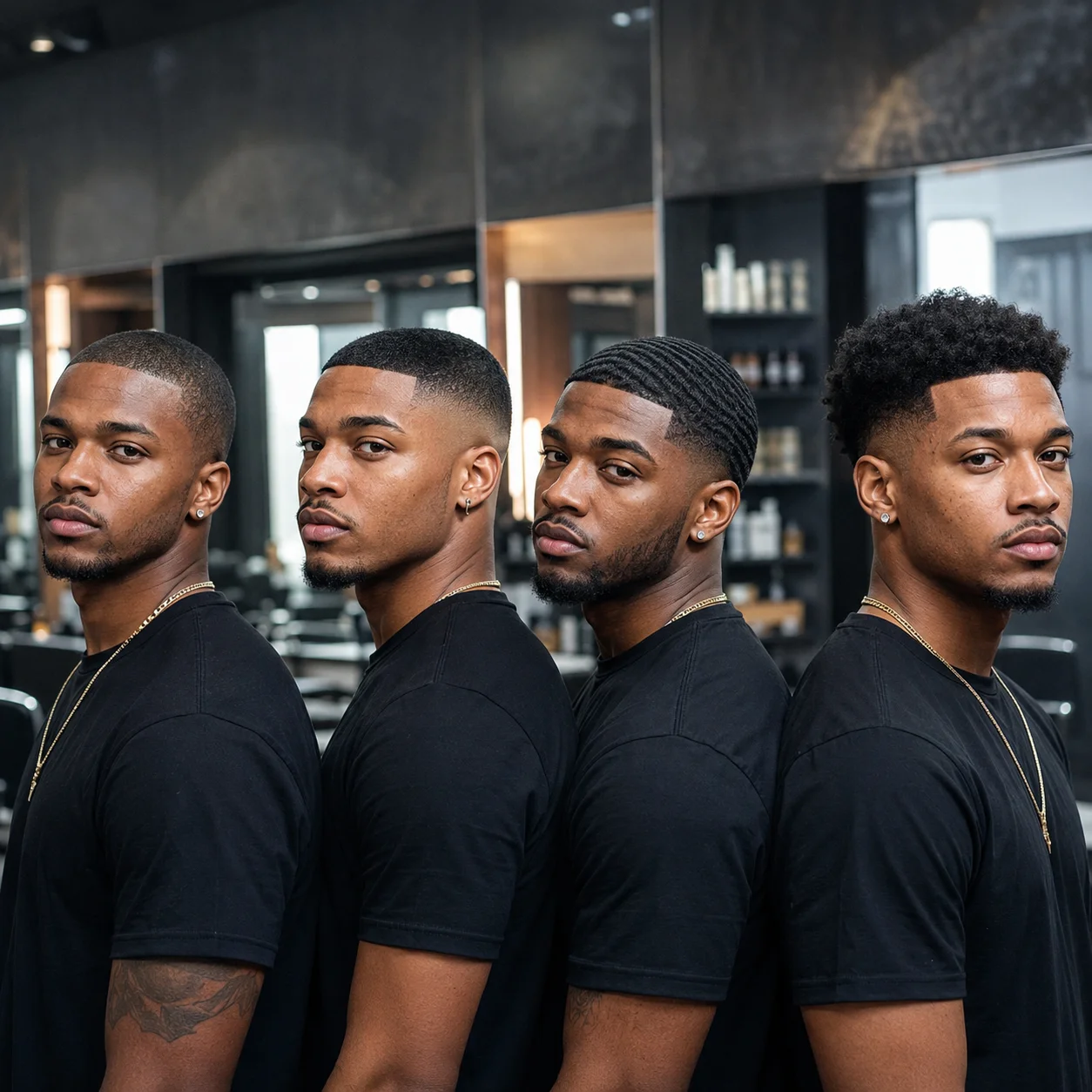

It’s one of the most common questions men ask before sitting in the barber’s chair:
“Should I get a skin fade or a taper fade?”
Both are enormously popular. Both involve graduated shortening of hair on the sides and back. And yet they produce noticeably different results — different levels of contrast, different vibes, different maintenance requirements, and different levels of suitability depending on your face shape, hair type, and lifestyle.
If you’ve ever walked out of a barbershop with something sharper or subtler than you intended, the skin fade vs taper fade distinction is probably where the miscommunication happened.
This guide settles it once and for all — a complete breakdown of both styles, how they differ, who each suits best, and exactly how to ask for whichever one you want.
The Core Difference — Explained Simply
Before anything else, here’s the clearest possible explanation of what separates these two styles:
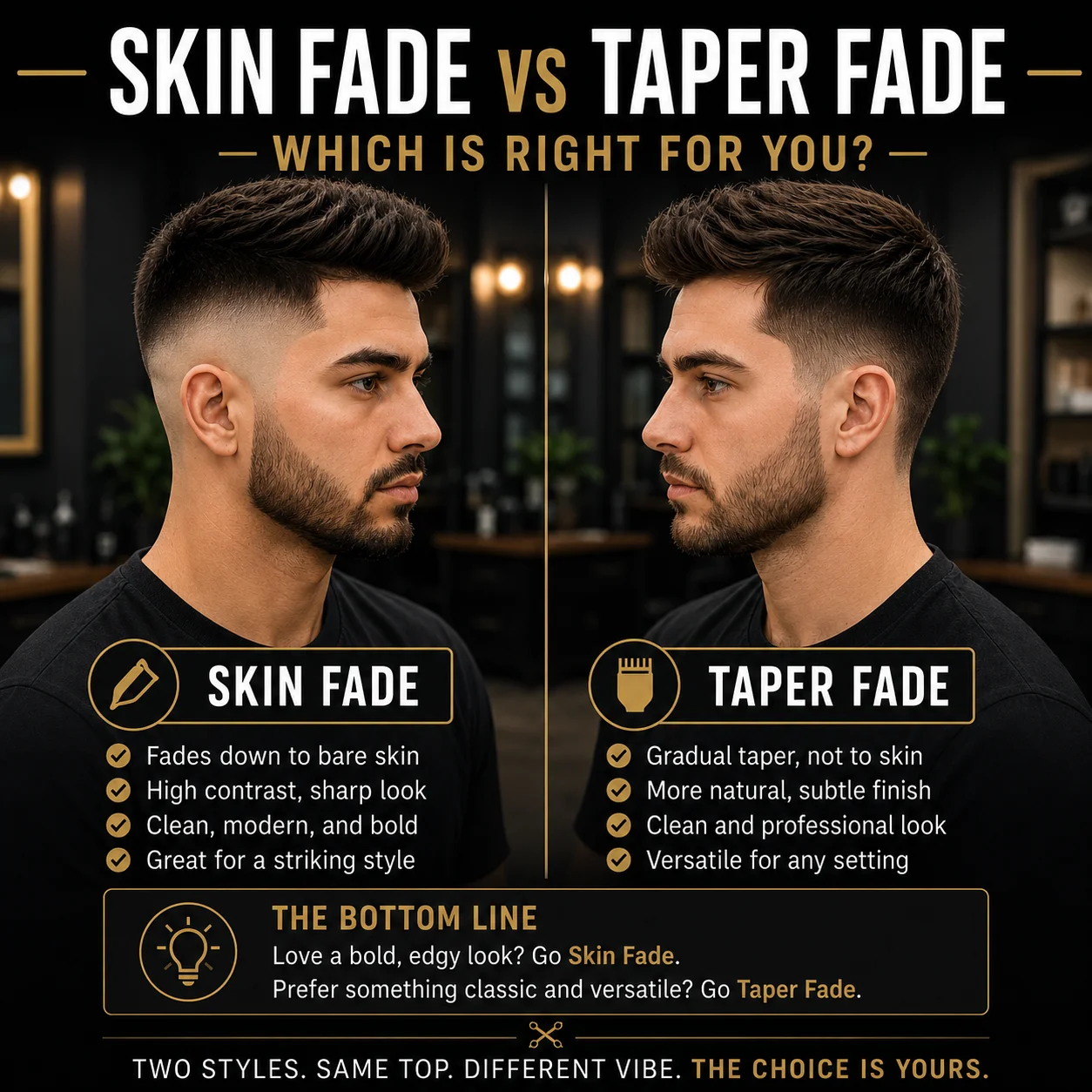
Skin fade (bald fade): The hair on the sides and back blends all the way down to bare skin — zero hair at the lowest point. The transition from full length on top to skin can be gradual or abrupt depending on the height and technique, but the endpoint is always bare scalp.
Taper fade: The hair on the sides and back shortens gradually — but it never goes all the way to skin. The hair at the lowest point is short, but there’s still visible hair there. The transition is typically longer and more gradual than a skin fade.
The simplest way to remember it:
Skin fade = hair blends to nothing (bare skin) Taper fade = hair blends to short (but still there)
Both are versions of the same fundamental technique — graduated shortening of hair from top to sides. The difference is purely how far that graduation goes.
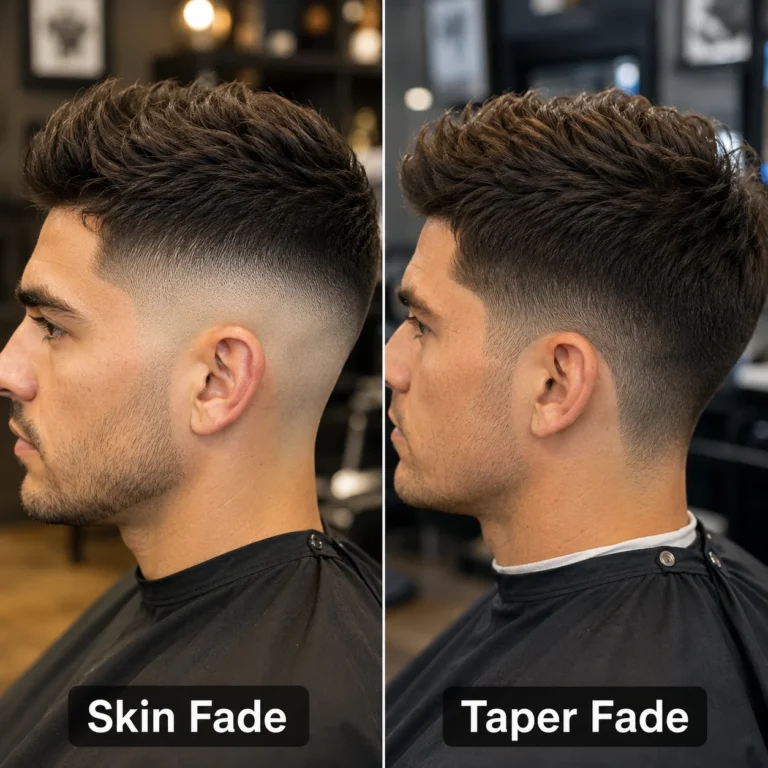
Skin Fade vs Taper Fade: The Full Comparison
| Feature | Skin Fade | Taper Fade |
|---|---|---|
| Lowest point | Bare skin (zero hair) | Short but visible hair |
| Contrast level | High — dramatic transition | Low to medium — subtle transition |
| Overall look | Bold, sharp, modern | Classic, clean, conservative |
| Best settings | Casual, social, fashion-forward | Office, formal, professional |
| Maintenance | Every 2–3 weeks | Every 3–5 weeks |
| Grows out | Visibly — skin shows regrowth fast | Cleanly — less noticeable growth |
| Best face shapes | Oval, round (adds definition) | All face shapes — especially square, oblong |
| Best hair types | Works on all types | Works on all types |
| Barber skill required | Higher — skin blending is technical | Standard — more forgiving technique |
Understanding the Skin Fade
What it looks like
A skin fade is exactly what it sounds like — a fade that reaches bare skin. At the lowest point (around the ears and neckline), you can see the scalp completely. Moving upward, the hair gradually increases in length until it meets the full length on top.
The height of the skin fade — low, mid, or high — determines where on the head the bare skin begins:
- Low skin fade — bare skin starts just above the ears and neckline. The bare-skin effect is subtle and the fade happens over a small area.
- Mid skin fade — bare skin extends up to temple level. This is the most popular skin fade height globally in 2026.
- High skin fade — bare skin extends almost to the crown. Maximum contrast, maximum boldness. The top hair sits on a nearly-shaved canvas.
Who the skin fade suits best
Face shapes: Skin fades work best on oval and round faces. The high contrast and definition of a skin fade adds structure and angular quality to softer face shapes. For square and oblong faces, the skin fade can sometimes over-emphasize strong features — though a low skin fade remains wearable on most face shapes.
Hair types: Skin fades work on all hair types — but they look most striking on thick, dense hair where the contrast between full length on top and bare skin on the sides is most dramatic. For fine hair, a skin fade can work but the top needs enough density to create a meaningful contrast.
Lifestyle: The skin fade projects a modern, fashion-forward image. It’s the dominant style in barbershop culture, streetwear, and urban fashion. In very formal or conservative professional environments, a high skin fade may read as too bold — a mid skin fade is typically the most versatile option for professional settings.
The skin fade’s one major downside
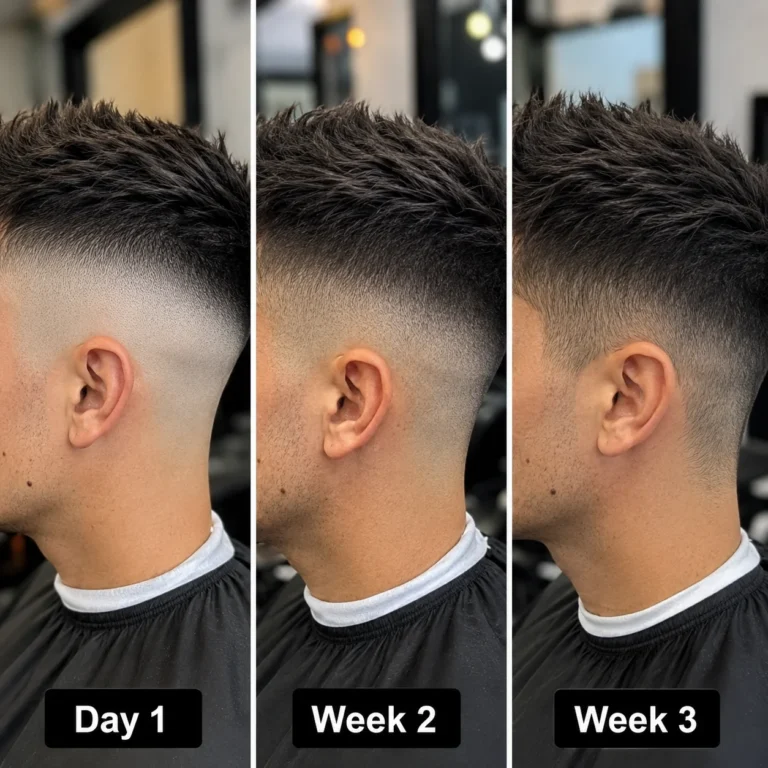
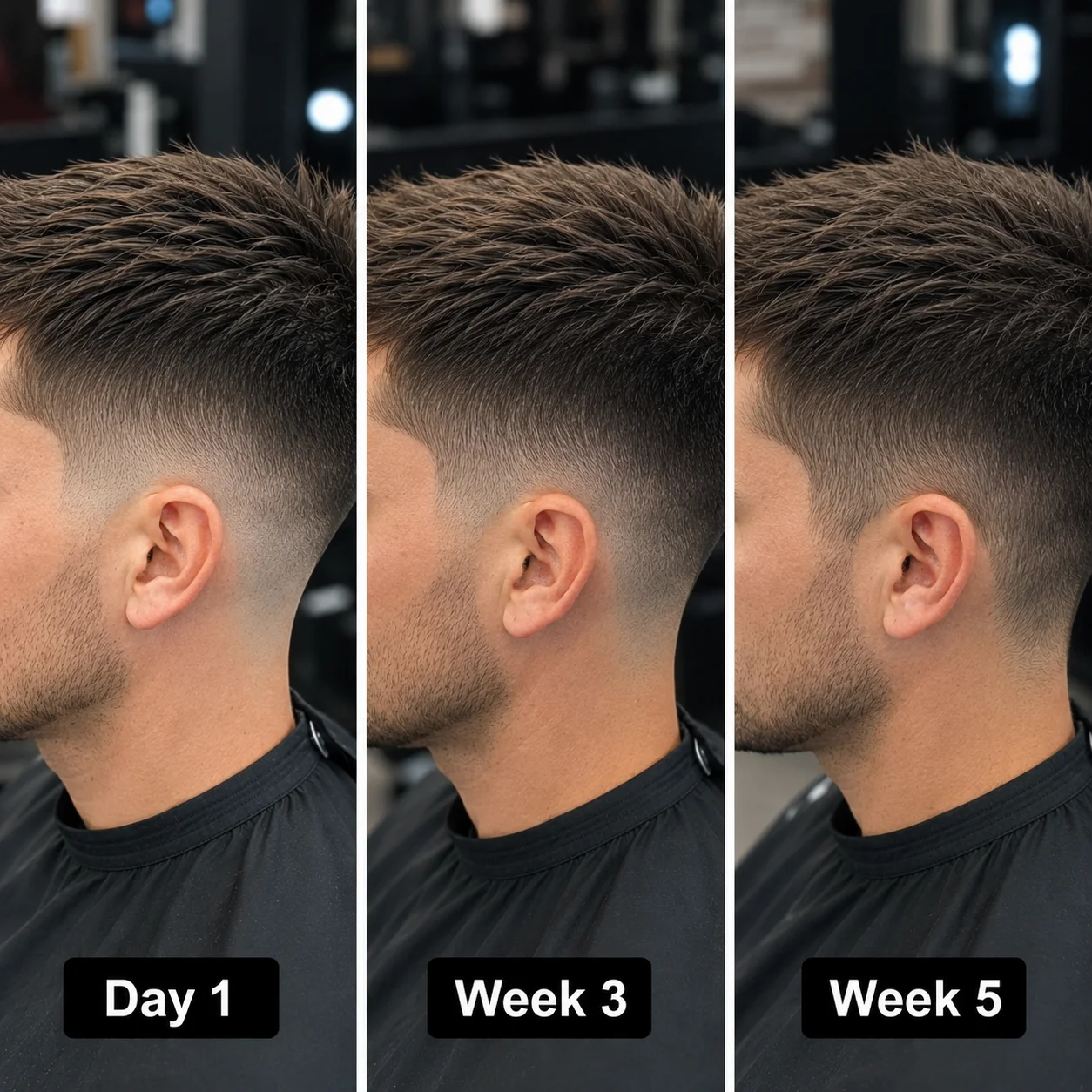
It grows out fast and visibly. Bare skin shows stubble within days — by 2 weeks, a skin fade looks noticeably grown out. By 3 weeks it can start looking unkempt. Men with skin fades typically visit their barber every 2–3 weeks to maintain the look — which is both a time and financial commitment.
Understanding the Taper Fade
What it looks like
A taper fade shortens the hair gradually from the full length on top toward the neckline and ears — but the hair never disappears entirely. At the lowest point, you might see a number 1 (3mm) or even a number 0.5 (1.5mm), but there’s still hair there. The transition is typically longer and more gradual than a skin fade, creating a softer overall silhouette.
The taper fade exists on a spectrum:
- Low taper fade — the tapering begins just above the ears. Very subtle, conservative, clean. Best for formal settings.
- Mid taper fade — tapering begins around temple level. The most versatile option — works in virtually any setting.
- High taper fade — tapering begins near the crown. More bold than a standard taper but still softer than a skin fade at the same height.
Who the taper fade suits best
Face shapes: The taper fade is the most universally flattering option across all face shapes. Its softer contrast means it doesn’t over-accentuate strong features the way a high skin fade can. For square and oblong faces in particular, a taper fade is often the recommended choice over a skin fade.
Hair types: Like the skin fade, taper fades work on all hair types. For men with receding hairlines or fine hair, a low taper is often the recommended choice — it creates clean structure without exposing too much scalp or drawing attention to thinning areas.
Lifestyle: The taper fade is the most professional and versatile fade option. It works in corporate environments, formal occasions, and casual settings equally well. It’s the modern equivalent of the classic “short back and sides” — timeless, reliable, universally appropriate.
The taper fade’s key advantage
It grows out gracefully. Because the lowest point still has some hair, the transition zone grows in naturally rather than showing visible stubble against bare skin. A taper fade typically looks clean for 4–5 weeks before needing a refresh — significantly longer than a skin fade. This means fewer barbershop visits and less maintenance overall.
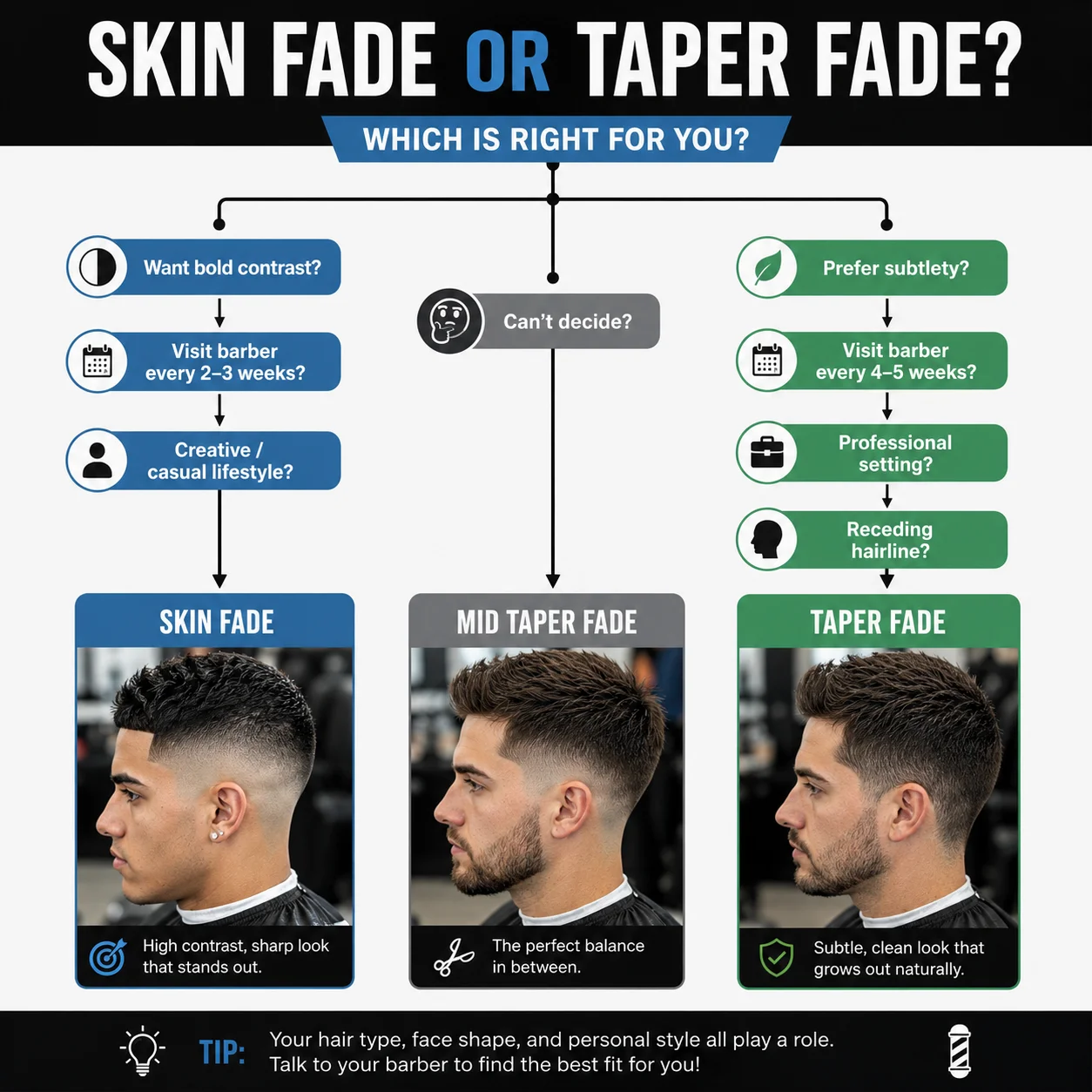
Which One Should You Choose?
Use this decision guide to find your answer:
Choose a skin fade if:
- ✓ You want maximum contrast and a bold, modern look
- ✓ You visit your barber regularly (every 2–3 weeks)
- ✓ You have an oval or round face shape
- ✓ You have thick, dense hair that creates strong contrast
- ✓ You work in a creative, casual, or fashion-forward environment
- ✓ You want your haircut to make a statement
- ✓ You’re pairing it with a bold top style (pompadour, quiff, afro, Edgar cut)
Choose a taper fade if:
- ✓ You prefer a cleaner, more conservative look
- ✓ You can only get to the barber every 4–5 weeks
- ✓ You have a square, oblong, or strong-featured face shape
- ✓ You work in a professional or formal environment
- ✓ You have a receding hairline or fine hair
- ✓ You want a style that grows out cleanly
- ✓ You’re new to fades and want to start with something less dramatic
Can’t decide? Start with a mid taper fade
If you’re genuinely unsure, start with a mid taper fade. It’s the most universally flattering option — enough definition to look modern and sharp, subtle enough to work in any setting and grow out cleanly. Once you’ve worn it for a few cycles and know whether you want more or less contrast, you can dial up to a skin fade or down to a low taper from there.
Best Styles for Each
Best styles with a skin fade
Textured crop — the clean precision of a skin fade contrasts beautifully with the textured, deliberately messy crop on top.
Edgar cut — the Edgar’s signature blunt fringe is made for a skin fade. The geometric top and bare-skin sides are the defining combination of this style.
Pompadour — the volume and height of a pompadour is framed perfectly by a mid or high skin fade.
Afro with skin taper — the natural fullness of an afro against a clean skin taper is one of the most striking visual contrasts in men’s grooming.
Curly top — curly hair on top of a skin fade creates natural volume and definition that looks extraordinary.
Best styles with a taper fade
Comb over — the modern comb over’s clean, structured quality is best served by a low or mid taper that keeps the transition natural.
Crew cut — a classic crew cut with a taper fade is the most enduring professional haircut in existence. Works everywhere, suits everyone.
Slick back — sophisticated and polished, the slick back works best with a mid taper that keeps the look restrained and elegant.
Side part — a natural side part paired with a low taper is the go-to business haircut — conservative, versatile, always appropriate.
Waves — 360 waves are best maintained with a taper that preserves the wave pattern while cleaning up the perimeter.
Asking Your Barber for Each
For a skin fade
“Can I get a [low/mid/high] skin fade please — I want it to go all the way down to skin at the sides.”
Additional specifics to add:
- The top style: “…with a textured crop on top”
- A line up: “…and a line up on the hairline”
- The neckline: “…and a tapered neckline at the back”
For a taper fade
“Can I get a [low/mid/high] taper please — I don’t want it to go all the way to skin, just a clean taper.”
Additional specifics:
- How short at the bottom: “…take it down to a number 1 at the shortest”
- The top: “…with a natural side part and 2 inches on top”
- The neckline: “…tapered neckline please”
The most important word to use: When asking for a taper fade, say “taper” explicitly — not just “fade.” Many barbers default to a skin fade when they hear “fade” without further specification. Saying “taper” signals that you want hair remaining at the bottom, not bare skin.
Frequently Asked Questions
What is the difference between a skin fade and a taper fade? A skin fade blends the hair all the way down to bare skin at the sides and back — no hair at the lowest point. A taper fade shortens the hair gradually but retains some hair at the lowest point, never going completely to skin. A skin fade is bolder and higher-contrast; a taper fade is subtler and more conservative.
Which lasts longer — skin fade or taper fade? A taper fade lasts significantly longer. Because the lowest point still has some hair, growth is less immediately visible — a taper fade typically looks clean for 4–5 weeks. A skin fade shows stubble against bare skin within days and usually needs refreshing every 2–3 weeks.
Is a skin fade the same as a bald fade? Yes — skin fade and bald fade refer to the same thing. Both describe a fade where the hair blends completely down to bare skin. The terms are used interchangeably in barbershops.
Can I ask for a taper fade without going to skin? Yes — that’s exactly what a taper fade is. If you want a clean, graduated transition on the sides without bare skin, a taper fade is the correct request. Tell your barber: “Taper fade please — I don’t want it to go all the way to skin.”
What is a low taper vs a skin fade? A low taper begins just above the ears and neckline, shortening gradually but not to bare skin — the lowest point still has short visible hair. A skin fade can start at any height (low, mid, or high) but the defining characteristic is that it always reaches bare skin at the lowest point. A low taper is more subtle; a skin fade is more dramatic regardless of height.
Which fade is more professional — skin or taper? For most professional environments, a low or mid taper fade is considered the more appropriate option. It’s cleaner and more conservative than a skin fade while still being a modern, well-groomed style. That said, mid skin fades are increasingly accepted in most workplaces in 2026 — only very conservative industries (law, finance, government) might still prefer the subtlety of a taper.
Final Thoughts
Skin fade or taper fade — both are excellent choices, and both have their place depending on who you are, how you live, and how often you’re willing to sit in the barber’s chair.
The skin fade gives you maximum impact and a bold, modern look. The taper fade gives you versatility, longevity, and a timeless quality that never reads as too much.
Know what you want, use the right words to ask for it, and you’ll walk out of the barbershop looking exactly right every single time.