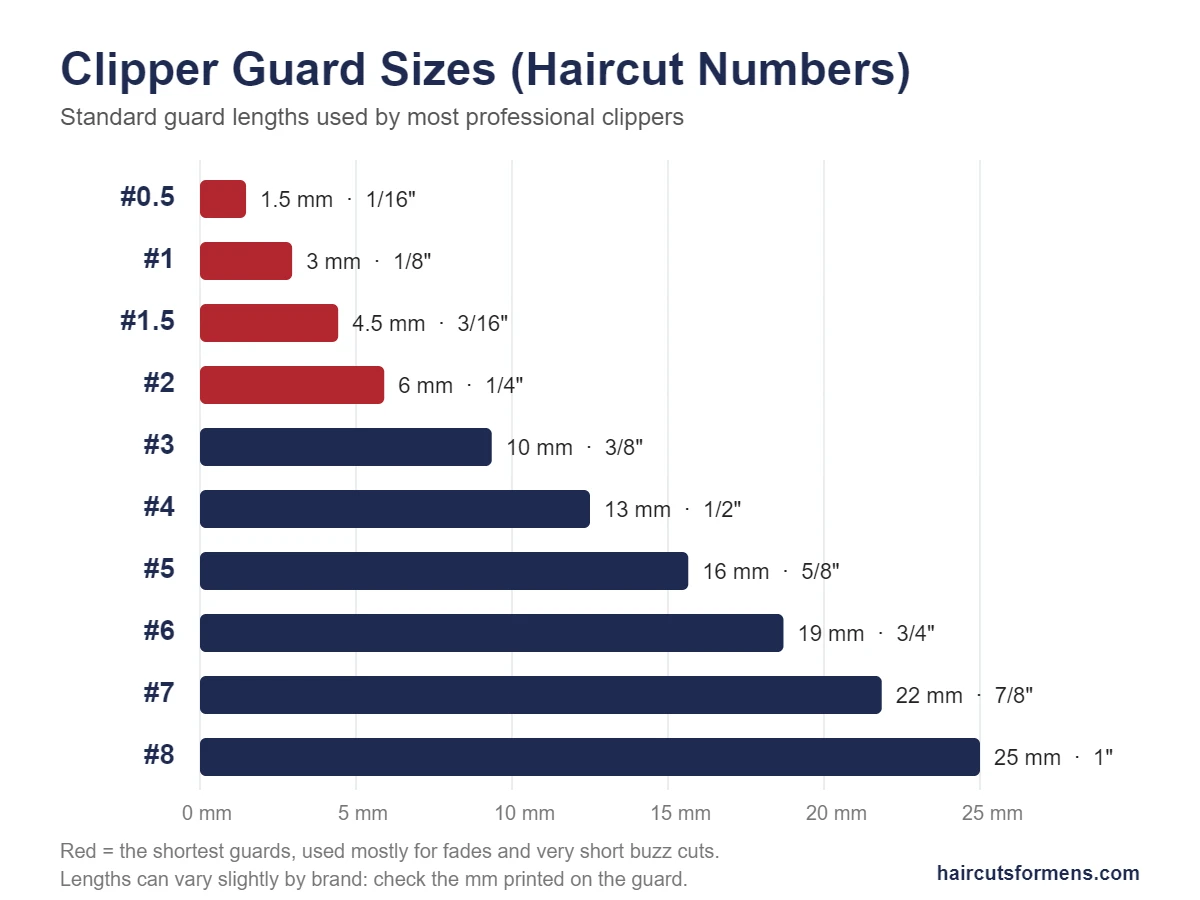
“Number 2 on the sides” is one of the most common things said in a barbershop, but most people don’t know what it actually looks like. Haircut numbers are simply the sizes of the plastic guards that clip onto the clippers: the higher the number, the longer the hair is left. This guide explains every number from 0 to 8 in millimetres and inches, what each one looks like, how barbers combine them in a fade, and exactly what to say in the chair.
Quick answer: on most clippers, a #1 leaves about 3 mm (1/8″), a #2 about 6 mm (1/4″), a #3 about 10 mm (3/8″) and a #4 about 13 mm (1/2″). Each full number adds roughly 3 mm, up to a #8 at about 25 mm (1″). In the UK the same sizes are often called grades, so a “grade 2” is the same as a number 2.
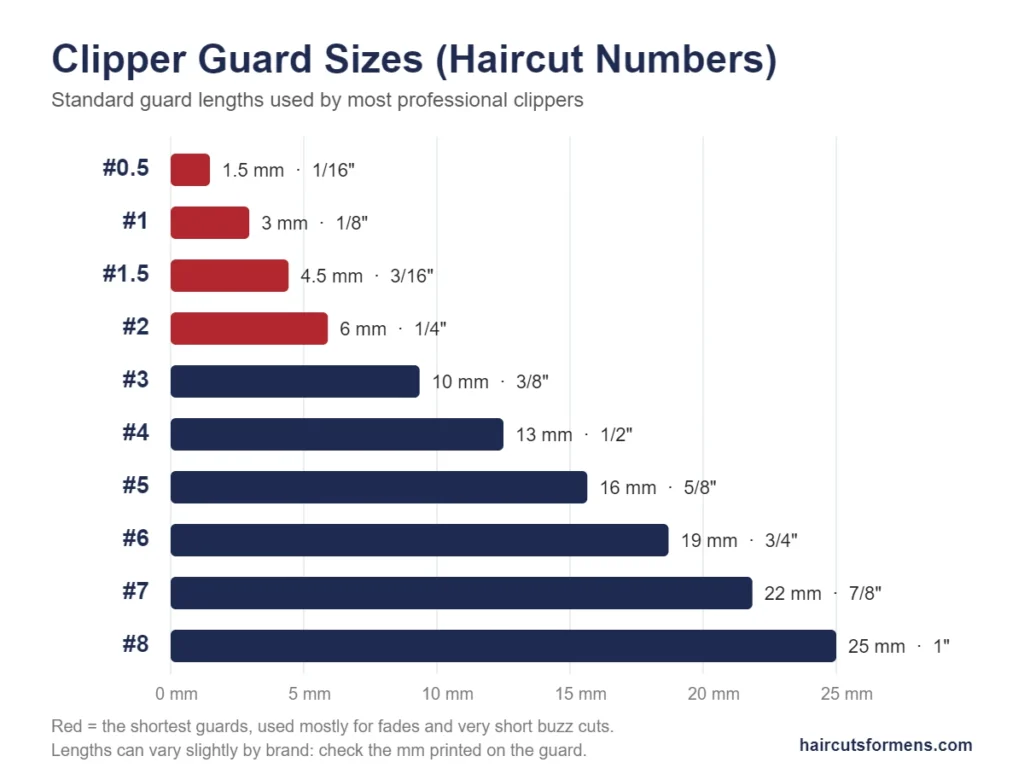
Haircut Numbers Chart
| Number | Length | What it looks like | Typical use |
|---|---|---|---|
| No guard | about 0.5 to 1.5 mm | Very short stubble, scalp clearly visible | Bottom of a fade, very close buzz |
| #0.5 | 1.5 mm (1/16″) | Shadow of hair, scalp visible | Fades, tight buzz cuts |
| #1 | 3 mm (1/8″) | Very short, even texture | Short buzz, fade blending |
| #1.5 | 4.5 mm (3/16″) | Between a #1 and #2 | Blending in fades |
| #2 | 6 mm (1/4″) | Short but fuller, less scalp showing | Classic buzz, short sides |
| #3 | 10 mm (3/8″) | Soft, even length | Longer buzz, sides of a crew cut |
| #4 | 13 mm (1/2″) | Short hair you can just about push around | Crew cut tops, longer sides |
| #5 | 16 mm (5/8″) | Enough to style with a little product | Short tops, all-over clipper cuts |
| #6 | 19 mm (3/4″) | Can be pushed forward or to the side | Longer clipper tops |
| #7 | 22 mm (7/8″) | Short-medium length | Tops, blending into scissor work |
| #8 | 25 mm (1″) | The longest standard guard | Longest clipper cuts; longer than this is scissors |
These are the standard lengths used by most professional clipper brands. If you cut at home, see our guide to the best tools for cutting your own hair at home. Cheaper home kits and some brands can be slightly different, so if the length matters, check the millimetre size printed on the guard rather than relying on the number alone.
What Each Number Looks Like
No guard and #0.5
With no guard at all, the clipper blade cuts to roughly 0.5 to 1.5 mm, depending on the clipper and the lever position. A #0.5 (1.5 mm) is similar. Both leave a dark shadow on dark hair and show plenty of scalp on light or fine hair. Barbers mostly use them at the bottom of a fade rather than all over.
#1: very short
About 3 mm. A #1 all over is a very short buzz cut that still covers the scalp on most dark, thick hair. On blond, grey or fine hair, more scalp will show. It is also a common starting point for low fades and tapers.
#2: the classic buzz cut
About 6 mm. This is the length most people picture when they think of a buzz cut, and the most common number asked for on the sides. It looks neat, hides most of the scalp and grows out gracefully. See more in our buzz cut vs crew cut guide.

#3: softer and fuller
About 10 mm. A #3 all over is a longer, softer buzz cut, and a popular choice for men who want a short cut that doesn’t look severe. It is also a common length for the sides above a fade.

#4: crew cut territory
About 13 mm. At this length hair starts to move and can be pushed slightly with your hand. A #4 is often used on top of a short crew cut, or on the sides if you want a conservative, fuller look.

#5 to #8: clipper cuts with length
A #5 (16 mm) and #6 (19 mm) leave enough hair to style with a little product, part or push forward. A #7 (22 mm) and #8 (25 mm) are the longest standard guards and are mostly used on top. Anything longer than about 1 inch is usually cut with scissors instead.
Half Numbers and the Clipper Lever
Many barber guard sets include half sizes such as a #0.5 (1.5 mm) and #1.5 (4.5 mm). They exist for blending: in a fade, jumping straight from a #1 to a #2 can leave a visible line, so a half size smooths the step.
Most clippers also have a lever on the side that moves the blade slightly. Closed, it cuts at the guard’s stated length; opened, it leaves the hair a little longer. Barbers use the lever to create the in-between lengths that make a fade look seamless.
How Numbers Work in a Fade or Taper
A fade or taper isn’t one number. The barber starts with the shortest length at the bottom (skin, no guard or a #0.5) and works up through longer guards, blending each step into the next until it meets the hair on top. The height of the fade is where that blend starts: just above the ears for a low fade, around the temples for a mid fade and higher up the head for a high fade.
A taper usually stays longer at the bottom, often a #1 or #2, and only shortens around the ears and neckline. A skin fade goes all the way down to bare skin. Our guide to skin fade vs taper fade explains the difference in detail.
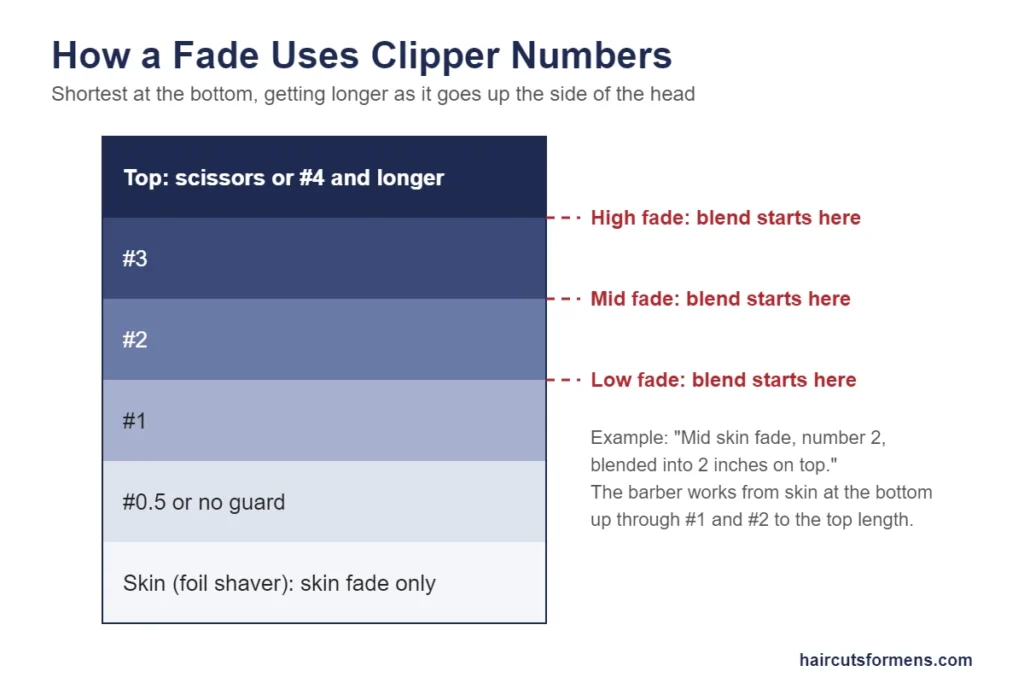
When you ask for a fade, the useful numbers to give are the shortest length at the bottom and the length on top. For example: “Low taper, number 1 at the bottom, blended into a number 4 on top” or “Mid skin fade, 2 inches on top”. The barber chooses the in-between guards.

How to Choose Your Number
| If you want… | Try |
|---|---|
| The shortest low-effort cut that still covers the scalp | #2 all over |
| A softer, less severe buzz | #3 or #4 all over |
| Short sides that still look full | #2 or #3 on the sides |
| A sharp, high-contrast look | A fade starting at skin or #0.5 |
| A conservative office cut | Low taper starting at #1 or #2, length on top |
| A clipper cut you can still style | #5 to #8 on top |
Two things change how a number looks on you. Hair colour: dark hair looks fuller at short lengths, while blond, grey or fine hair shows more scalp, so it’s worth going one number longer. Head shape and scalp: very short numbers show bumps, scars and the shape of your head. If you’re unsure, start longer: your barber can always take more off, but can’t put it back.

What to Say to Your Barber
- Buzz cut: “Number 2 all over, tidy up the neckline.”
- Crew cut: “Number 2 on the sides, number 4 on top, blended.”
- Taper: “Low taper starting at a number 1, leave 2 inches on top.”
- Skin fade: “Mid skin fade, blended up into a number 3, textured on top.”
If you’re between two numbers, ask for the longer one first. For more phrases, see our guide on how to ask your barber, or use the barber instruction generator to build your request.
How Long Each Number Lasts
Hair grows roughly a centimetre a month on average, so the shorter the number, the faster a cut looks grown out. A skin fade or #0.5 can look soft within a week or two, while a #3 or #4 all over usually stays tidy for several weeks. If you like a sharp look, book shorter cuts more often. Our low maintenance haircuts guide covers styles that stretch between visits.
FAQ
What is a number 2 haircut?
A haircut cut with a #2 clipper guard, leaving about 6 mm (1/4″) of hair. It’s the classic buzz cut length and a common choice for the sides.
Is a number 1 or number 2 shorter?
A number 1 is shorter, at about 3 mm. The lower the number, the shorter the hair.
What is a grade 2 haircut?
“Grade” is the term used in the UK and some other countries. A grade 2 is the same as a number 2: about 6 mm.
What number is a crew cut?
Usually a #2 or #3 on the sides with a #4 or longer on top, blended together. See our buzz cut vs crew cut guide.
What number is a skin fade?
A skin fade starts at bare skin, cut with no guard and often finished with a foil shaver, then blends up through #0.5, #1 and #2. More in our fade haircuts guide.
Are clipper numbers the same on every brand?
Most professional brands use the same standard lengths, but some home kits differ slightly. Check the millimetre size on the guard if you’re cutting at home. For clippers with a full guard set and a taper lever, see our best hair clippers for fades at home.