
Lampshade Mustache: How to Grow, Trim and Style It

Picture of Jaan
Jaan

Grooming Editor, HairCutsForMens
Jaan has spent the last several years testing beard and hair grooming trends as they move from barbershops into everyday wear — trying the trims, tools, and routines firsthand before writing about them. He focuses on practical, no-nonsense advice: what actually works day-to-day, not just what looks good in a photo. When he's not researching the next trend, he's usually the one testing a new trimmer guard length on himself first.

Close-up portrait of a stylish modern man with a Lampshade mustache.

A lampshade mustache is a neat, structured style with a subtle trapezoid or pyramidal outline, slightly narrower near the upper lip and wider beneath the nose. It sits close to the mouth without extending past the corners, giving it a clean, tailored look

Side profile of a lampshade mustache trimmed above the upper lip

What Is a Lampshade Mustache?

The lampshade mustache gets its name from its resemblance to a lampshade’s tapered silhouette: narrower at the top, near the base of the nose, and gradually widening toward the bottom edge above the upper lip. This isn’t a sharp, geometric shift — it’s a gentle taper that gives the style its structured but natural appearance.

Its outer boundaries typically stop at or just inside the corners of the mouth. This keeps the mustache compact and prevents it from spilling onto the cheeks or drooping past the lip line. The overall shape reads as deliberate and tidy rather than bushy or overgrown.

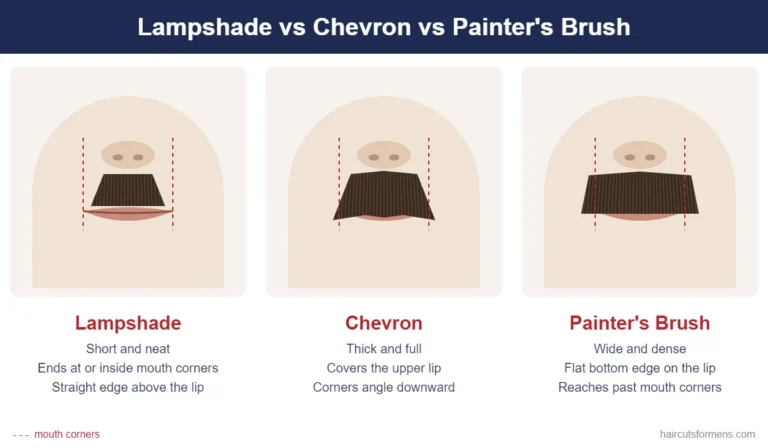
Because grooming terminology isn’t standardized across barbers, magazines and online guides, you’ll sometimes see the lampshade mustache described in ways that overlap with the painter’s brush, pyramid or chevron styles. The distinctions are often about the sharpness of the taper and how much of the upper lip is covered.

What Does a Lampshade Mustache Look Like?

Picture the mustache anchored at the philtrum (the vertical groove between the nose and upper lip) and fanning outward as it descends. The top edge sits close to the base of the nose, while the bottom edge extends just over the upper lip.

The sides taper inward as they rise, so the mustache is visibly fuller near the mouth than it is near the nostrils. The outer edges are trimmed to end at or slightly inside the corners of the mouth — not flaring outward toward the cheeks.

Unlike a fully rectangular block mustache, the lampshade retains a soft, tapered geometry. It should look intentional and even, but not stiff or artificially squared off.

Lampshade Mustache Quick Facts

AttributeDetails
ShapeSubtle trapezoid or pyramidal taper
Growth timeRoughly 4–8 weeks for workable density
Typical lengthShort to medium; enough for shape, not bulk
Best growth densityMedium to full; thin patches make shaping harder
Maintenance levelModerate — regular trims to hold the taper
Recommended toolsTrimmer with guard settings, small grooming scissors, fine-tooth comb
Common alternative namesLampshade moustache, trapezoid mustache, pyramidal mustache

Lampshade vs. Chevron vs. Painter’s Brush

Comparison of lampshade, chevron and painter's brush mustache shapes
FeatureLampshadeChevronPainter's Brush
ShapeTapered trapezoidStraight, thick rectangleFuller, rounded bottom
WidthEnds at or inside mouth cornersOften extends past mouth cornersSimilar width, fuller center
FullnessModerateFull and thick throughoutFuller, especially at center
Lip coverageCovers upper lip evenlyFully covers upper lipFully covers upper lip, more volume
MaintenanceModerateModerate to highModerate to high

The lampshade also gets compared to two other structured styles. The pyramid mustache shares the same tapered logic but can appear with a more pronounced angle, while the boxcar mustache is squared off and rectangular with minimal taper, making it visually blockier than the lampshade.

Who Does a Lampshade Mustache Suit?

Facial-hair density matters more than face shape when it comes to pulling off a lampshade mustache. Because the style relies on a visible taper, thinner growth can make the shape harder to define. Fuller growth gives you more room to trim precisely.

Oval faces tend to suit most mustache shapes, including the lampshade, since the proportions are naturally balanced.

Round faces can often benefit from a slightly narrower lampshade, since a compact shape avoids adding visual width to the lower face.

Square faces generally have strong jawlines that pair well with the structured taper of a lampshade, reinforcing rather than competing with the face’s angles.

Rectangular or oblong faces may want to keep the mustache from growing too thick vertically, since added bulk in that area can emphasize length.

Heart and diamond faces can usually wear the lampshade comfortably, though slightly softening the outer edges may help balance a narrower jaw or chin.

These are general tendencies, not fixed rules. Adjusting thickness and width lets most face shapes work with the style.

How Long Does It Take to Grow?

Most men need approximately four to eight weeks before there’s enough density to shape a lampshade mustache cleanly. Genetics play a significant role, so growth speed and thickness will vary from person to person.

Week 1–2: Growth is patchy and uneven. Resist the urge to trim yet.

Week 3–4: Coverage starts to fill in. You can begin light trimming for length control, but avoid shaping the taper.

Week 5–6: Density is usually sufficient to identify the natural boundaries of the mustache and begin light shaping.

Week 7–8: Most men have enough growth to establish the full lampshade taper and refine the edges.

These timeframes are general guidelines. Some men reach workable density sooner, while others need additional weeks.

How to Trim a Lampshade Mustache
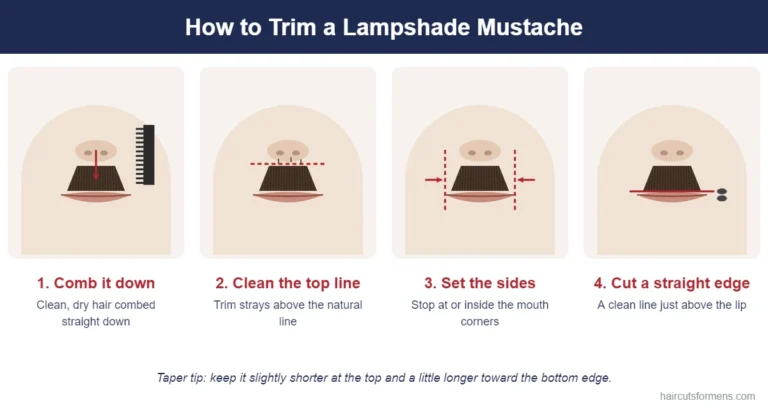
Before you trim, check this list:

  • Mustache has grown for at least four weeks
  • Hair is clean, dry and combed downward
  • You have a trimmer with adjustable guards, small scissors and a comb
  • You’re in good lighting with a clear mirror

The trimming process:

  1. Let the mustache develop sufficient coverage. Trimming too early makes it difficult to see the natural shape and boundaries.
  2. Wash, dry and comb it downward. Wet or tangled hair distorts length, leading to uneven trims.
  3. Start with a longer trimmer guard. Begin conservatively; you can always take off more length later.
  4. Establish the upper boundary. Trim any stray hairs growing above the natural mustache line near the nose.
  5. Mark the outer boundaries at or inside the mouth corners. This keeps the mustache from flaring outward.
  6. Create the subtle top-to-bottom taper. Trim slightly shorter near the top and allow a bit more length near the bottom edge.
  7. Define the lower lip line. Trim hair that hangs over the lip for a cleaner appearance.
  8. Check symmetry. Compare both sides in the mirror, adjusting for even width and taper.
  9. Finish with scissors or a precision trimmer. Use these for fine detail work around the edges.
  10. Clean the surrounding facial hair. Tidy up stray hairs on the cheeks and chin area to keep the mustache looking intentional.

Removing hair gradually — rather than cutting deep on the first pass — helps you avoid over-trimming a shape that’s difficult to correct once it’s too short.

How to Maintain a Lampshade Mustache

Daily maintenance: Comb the mustache downward each morning and pat it dry after washing your face to keep the shape consistent.

Every few days: Check for stray hairs near the edges or above the natural boundary and trim them as needed.

Weekly reshaping: Revisit the taper and outer boundaries with your trimmer to prevent the shape from drifting outward or losing definition.

Light conditioning with a small amount of beard balm can help manage texture, but heavy product use isn’t necessary for this style. Regular, conservative trims are more effective than infrequent, aggressive ones.

Common Mistakes to Avoid

  • Trimming before there’s sufficient growth to see the natural shape
  • Making the mustache completely rectangular instead of tapered
  • Cutting it too narrow, which can look thin or sparse
  • Letting the ends extend too far past the mouth corners
  • Trimming the top line too low, close to the upper lip
  • Creating uneven sides due to inconsistent trimming angles
  • Using too much wax, which can flatten the natural taper
  • Confusing the lampshade with a chevron or painter’s brush and copying the wrong reference shape

Lampshade Mustache Variations

Classic lampshade: The standard taper with moderate width and even coverage.

Short lampshade: A closely trimmed version that keeps the taper subtle and low-maintenance.

Thick lampshade: Fuller growth left slightly longer, emphasizing density over precision.

Natural or textured lampshade: A looser interpretation with minimal shaping, relying on natural growth patterns.

Lampshade with stubble: Paired with light stubble on the rest of the face for a more casual, blended look.

Best Haircuts and Beard Pairings

Crew cut: A short, structured cut that mirrors the tidy lines of the lampshade mustache.

Buzz cut: Minimalist and low-maintenance, letting the mustache stand out as the main grooming detail.

Side part: A classic, polished cut that complements the mustache’s structured shape.

Taper fade: The gradual fade echoes the mustache’s own tapered logic, creating a cohesive look.

Textured crop: Adds visual interest on top while keeping the face clean around the mustache.

Clean-shaven face: Puts full focus on the mustache without competing facial hair.

Light stubble: Softens the look while still letting the mustache read as the defined feature.

[Image suggestion: A grid of haircut examples paired with a lampshade mustache.]

Famous Lampshade Mustache Examples

Miles Teller has been photographed with mustache styles that resemble a lampshade shape in some appearances, though the exact classification can shift depending on the photo and how recently it was trimmed.

Eddie Murphy has worn mustaches over the years that some grooming guides categorize as lampshade-style, particularly in more structured, tapered forms.

Sgt. Slaughter’s mustache is often referenced in discussions of thick, structured mustache styles, including comparisons to the lampshade shape, though his look leans fuller than a typical modern lampshade.

Because classification depends on interpretation, camera angle and grooming stage, these examples should be seen as reference points rather than strict definitions.

Frequently Asked Questions

1. Why is it called a lampshade mustache? The name comes from its tapered silhouette, which visually resembles the shape of a lampshade — narrower at the top and wider at the bottom.

2. Is a lampshade mustache the same as a chevron? No. A chevron is typically thicker, straighter and often wider at the mouth corners, while the lampshade has a more defined taper and narrower profile near the nose.

3. How wide should it be? The outer edges should generally sit at or inside the corners of the mouth, though exact width can be adjusted based on face shape and hair density.

4. Should it cover the upper lip? Yes, the lampshade mustache typically covers the upper lip evenly along its lower edge.

5. How long does it take to grow? Most men need about four to eight weeks of growth before there’s enough density to shape it properly, though this varies by individual.

6. What trimmer guard should I use? Start with a longer guard setting and gradually move to a shorter one as you refine the shape, rather than starting short and risking over-trimming.

7. Can it be worn with a beard or stubble? Yes, the lampshade mustache pairs well with light stubble or a closely trimmed beard, though it can also be worn on its own with a clean-shaven face.

8. Is it suitable for a patchy mustache? Patchy growth can make the taper harder to define. Waiting for fuller coverage generally produces better results.

9. How often should it be trimmed? Light upkeep every few days combined with a more thorough weekly reshaping typically keeps the style looking clean.

10. Is the lampshade mustache still fashionable? Structured mustache styles, including the lampshade, remain a common choice in modern grooming, particularly for men who prefer a tidy, defined look.

Final Verdict

The lampshade mustache suits men who want a structured, tapered look without the bulk of fuller styles like the painter’s brush. It works especially well for those with medium to full facial-hair density and a preference for regular, moderate upkeep. If you’re comfortable with a short growing-in period and consistent trimming, this style offers a clean, deliberate result.

Share the Post:

Related Posts