
Affiliate disclosure: this guide contains Amazon affiliate links in the product section. As an Amazon Associate I earn from qualifying purchases, at no extra cost to you. See our affiliate disclosure.
Cutting your own hair is a skill you can learn. A simple, even cut with clippers is very doable at home with the right tools and a careful, step-by-step approach. Fades take more practice, so start simple.
This guide covers setup, guard numbers, the cut itself and clean-up, with links to our buying guides for clippers, home haircut tools and lineup trimmers.
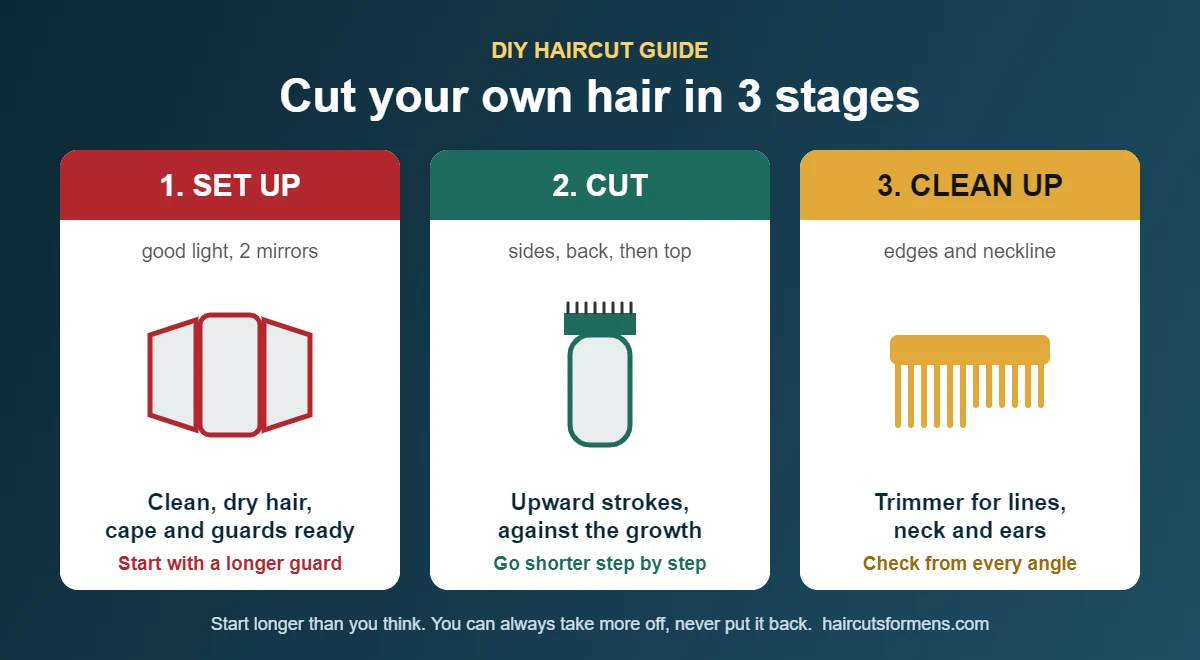
Quick answer: with clean, dry hair, good light and a three-way mirror, cut the sides and back upward with a longer clipper guard first, go shorter step by step, blend with half guards, trim the top with scissors or a long guard, and finish the neckline and ears with a trimmer.
Tools you need
| Tool | Why | Essential? |
|---|---|---|
| Clippers with guards | Even length on sides, back and top | Yes |
| Trimmer | Neckline, around ears, sharp lines | Yes |
| Three-way or handheld mirror | See the back of your head | Yes |
| Cape or towel | Keeps hair off your clothes | Recommended |
| Comb and scissors | Trimming the top and blending | For longer tops |
| Neck duster and blade oil | Cleanup and clipper care | Recommended |
Compare clippers in our clippers for fades at home guide and the rest of the kit in our home haircut tools guide.
Understanding guard numbers
Clipper guards are numbered by length. A lower number is shorter. Most brands follow a similar scale, but check your clipper’s chart.
| Guard | Approx. length | Typical use |
|---|---|---|
| #1 | 1/8 in (3 mm) | Short sides, fades |
| #2 | 1/4 in (6 mm) | Short sides |
| #3 | 3/8 in (10 mm) | Medium sides, short top |
| #4 | 1/2 in (13 mm) | Longer sides, short top |
| #6 to #8 | 3/4 to 1 in (19 to 25 mm) | Top on a clipper cut |
Our haircut numbers guide explains each number with examples.
Step 1: set up
- Wash and fully dry your hair. Clippers work best on clean, dry hair.
- Set up good light and mirrors. A bright bathroom with a three-way mirror, or a handheld mirror to see the back.
- Put on a cape or towel. Have guards, comb and trimmer within reach.
- Choose your lengths before you start. Write them down if it helps: for example #3 sides, #2 lower back, scissors on top.
Step 2: cut the sides and back
- Start with a longer guard than your goal. If you want a #2, start with a #3. You can always go shorter.
- Cut upward, against the growth. Use slow, overlapping strokes from the bottom of the sides up to where the head starts to curve.
- Do the back in sections. Use the mirror, work from the nape upward, and check often.
- Switch to the shorter guard. Repeat only on the lower part of the sides and back.
- Blend the line. Use a guard between the two lengths, or open the clipper lever, and flick outward at the line.
Step 3: cut the top
For a short clipper cut, run a longer guard (#6 to #8) front to back. For a longer top, use the scissor-over-comb or finger method: lift a small section between your fingers and trim the ends. Take off a little at a time.
- Comb the top straight up or forward. It shows uneven lengths.
- Trim in small sections. Match each section to the one before.
- Blend the top into the sides. Point-cut with scissors where they meet.
Step 4: clean up the edges
- Outline around the ears. Fold the ear down and trim a clean arc with a trimmer.
- Set the neckline. A natural or rounded neckline is easiest to keep even yourself.
- Remove stray hairs on the neck. Use the trimmer without a guard, carefully.
- Brush off loose hair. A neck duster helps.
Our lineup and edge-up tools guide covers trimmers for crisp lines.
Fades: try them later
A fade blends from very short at the bottom to longer at the top. It needs more guards, more blending and good mirror control. Get comfortable with an even cut first, then add a low fade. See our clippers for fades guide for clippers with adjustable blades.
Mistakes to avoid
- Starting too short.
- Rushing the back. Check it from several angles.
- Cutting wet hair with clippers.
- Forgetting the guard is clipped on properly. Check before every pass.
- Taking big sections off the top.
- Skipping clipper maintenance. Oil the blade and brush out hair after each cut.
Tools we recommend
These picks come from our detailed buying guides, where each product is compared on its Amazon listing, features and buyer ratings. We have not tested them hands-on. Follow the links to the full comparisons for ratings, pros and cons.

1. Wahl Color Pro Cordless Clipper
Colour-coded guards make it easy to remember your lengths.
Full comparison: best hair clippers for fades at home

2. Wahl Lithium Ion Pro Cordless Clipper
Our top pick in the clippers guide.
Full comparison: best hair clippers for fades at home

3. The 360 Mirror Trifold 3-Way Mirror
A three-way mirror, the tool that makes self-cutting manageable.
Full comparison: best home haircut tools

4. Wahl Secure-Snap Metal Clip Guard Set
A guard set with a caddy, from our home tools guide.
Full comparison: best home haircut tools

5. YELEGAI Hair Cutting Cape with Neck Duster
A cape and neck duster set for cleaner cuts at home.
Full comparison: best home haircut tools

6. BaBylissPRO FX+ Cord/Cordless Trimmer
Our top lineup trimmer pick.
Full comparison: best lineup and edge-up tools

7. ULG Professional Hair Cutting Scissors
Sharp hair scissors for scissor-over-comb trimming.
Full comparison: best home haircut tools

8. Wahl Premium Hair Clipper Blade Oil
A few drops after each cut keeps clippers running well.
Full comparison: best home haircut tools
Related guides
- Best hair clippers for fades at home
- Best home haircut tools
- Best lineup and edge-up tools
- Haircut numbers guide
- Best combs for men
Frequently asked questions
Is it hard to cut your own hair?
A simple, even clipper cut is manageable with practice. Fades and longer scissor cuts take more time to learn.
What clipper guard should I start with?
Start one or two numbers longer than your goal, then go shorter step by step.
How do I cut the back of my own head?
Use a three-way or handheld mirror, cut upward in small sections, and check often.
Should I cut my hair wet or dry?
Dry for clippers. Scissors can be used on slightly damp hair, but dry hair shows the true length.
How often should I cut my hair at home?
Every two to four weeks for short styles keeps the shape tidy.
What if I make a mistake?
Blend it with a slightly shorter guard over a wider area, or visit a barber to fix it.
As an Amazon Associate I earn from qualifying purchases. Product picks come from our buying guides, which compare each product using its Amazon listing and buyer ratings; we have not tested them hands-on.