The wolf cut has taken the men’s grooming world by storm — and in 2026, it shows absolutely no sign of slowing down.
Part mullet, part shag, entirely its own thing, the wolf cut sits at the intersection of effortless and intentional. It’s layered, textured, a little wild, and somehow works on almost every hair type and face shape. It’s the haircut that looks like you didn’t try — and that’s exactly why it’s so appealing.
But pulling it off takes more than just asking your barber to “make it look like a wolf cut.” The details matter: the right layers, the right length, the right styling technique for your hair type.
This guide covers everything — what the wolf cut actually is, every variation, who it suits, what to tell your barber, and how to style it at home.
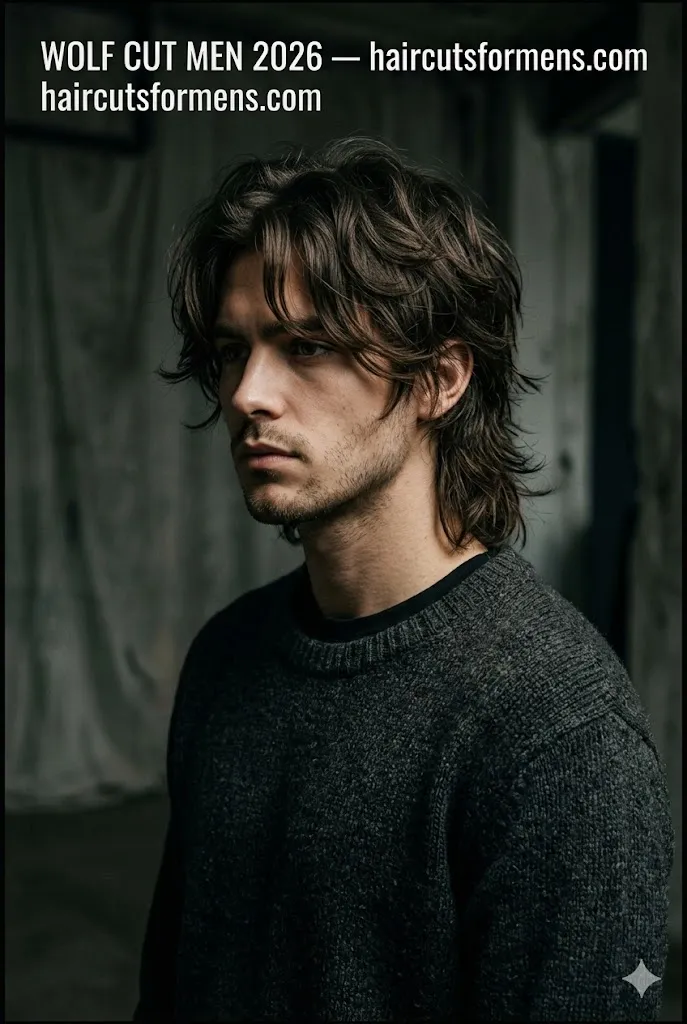
What Is the Wolf Cut?
The wolf cut is a medium-to-long layered haircut characterized by:
- Heavy layers throughout — creating volume at the crown and texture throughout
- Curtain bangs or wispy fringe at the front — falling to either side of the face
- Shorter, voluminous top that gradually transitions to longer lengths at the back and sides
- Shaggy, undone texture — it’s meant to look effortlessly tousled, not polished
The name comes from the wild, untamed look it creates — like a wolf’s mane. It borrows from two classic cuts: the shag (heavy layers, fringe) and the mullet (shorter on top, longer at the back) — but blends them into something more modern and wearable.
The wolf cut exploded in popularity on social media (especially TikTok and Instagram) and has since crossed over fully into mainstream barbershops. In 2026, it’s evolved beyond its Gen-Z origins — with older men, professional men, and men across every hair type adopting their own version.
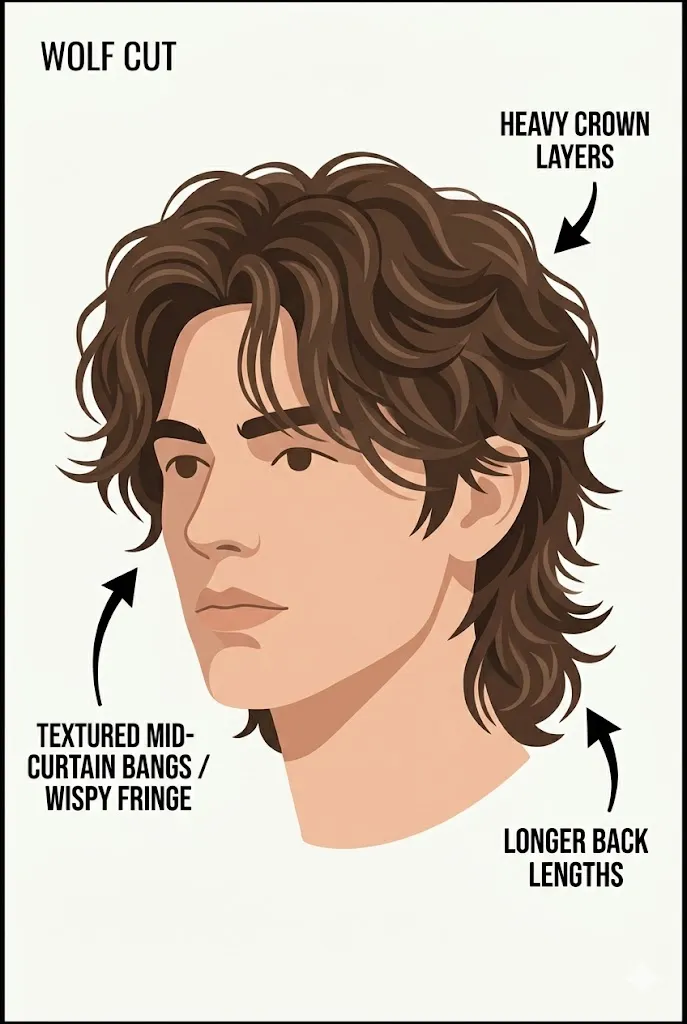
Wolf Cut vs Mullet: What’s the Difference?
Since the wolf cut borrows from the mullet, many men confuse the two. Here’s how they differ:
| Feature | Wolf Cut | Mullet |
|---|---|---|
| Layers | Heavy throughout | Minimal — mostly one length |
| Fringe | Curtain bangs / wispy fringe | Usually none or minimal |
| Texture | Shaggy, voluminous | Flatter, more structured |
| Back length | Slightly longer, blended | Distinctly longer — “business in front, party in back” |
| Overall vibe | Effortless, indie, editorial | Bold, retro, statement-making |
The simplest way to think of it: a mullet is a length contrast cut; a wolf cut is a texture and layer cut. The wolf cut is generally more wearable in everyday settings.
Who Does the Wolf Cut Suit?
The honest answer: most men. The wolf cut’s versatility is a big part of its appeal. But here’s how to match it to your specifics:
Best face shapes for the wolf cut:
- Oval — works perfectly, any variation
- Square — the softness of the layers and curtain bangs rounds out a strong jawline beautifully
- Round — go for more volume at the crown and less width at the sides; avoid very wide, puffy layers
- Oblong / long — the width of the wolf cut’s layers actually adds balance to a longer face
Best hair types:
- Wavy hair — the natural texture elevates the wolf cut effortlessly; this is the dream combination
- Curly hair — curls give the wolf cut incredible volume and personality; one of the best looks possible
- Straight hair — works well with the right styling products and technique (more on this below)
- Thick hair — benefits from the heavy layering, which removes bulk and creates movement
- Fine hair — possible, but requires a more careful approach (lighter layers, volumizing products)

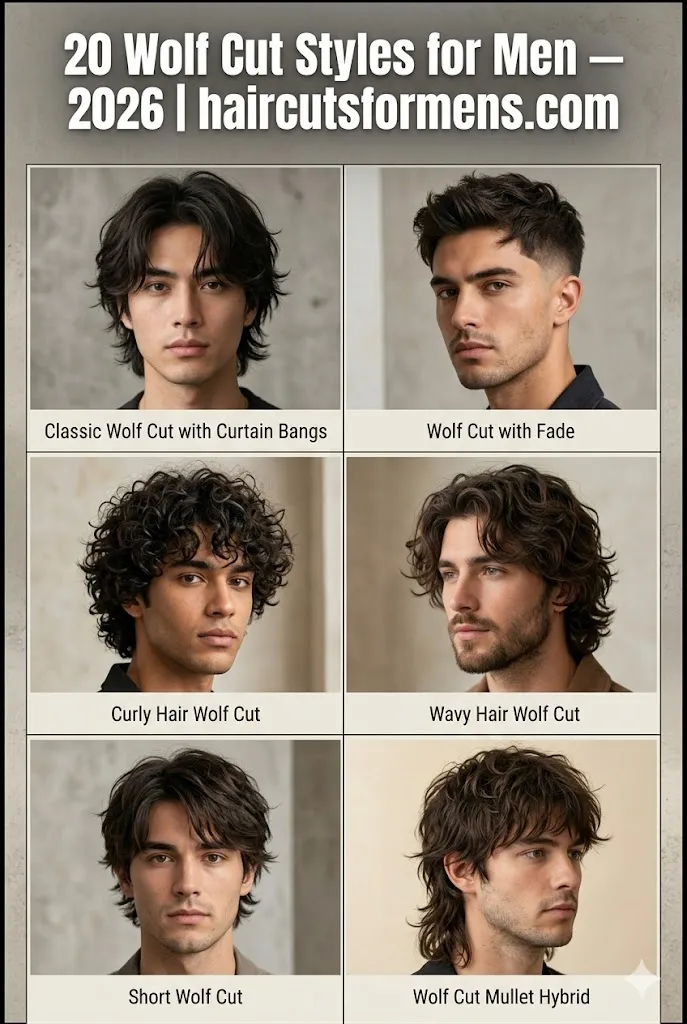
20 Wolf Cut Styles for Men in 2026
CLASSIC WOLF CUTS
1. The Original Wolf Cut Medium length (3–5 inches on top, slightly longer at back), heavy layers, curtain bangs falling to either side of the forehead. Tousled with a salt spray or light mousse. This is the foundational look — everything else on this list derives from it.
Barber tip: “Wolf cut please — medium length, heavy layers throughout, curtain bangs. I want it to look textured and a little undone.”
2. Short Wolf Cut A more wearable, lower-maintenance version. Shorter layers (2–3 inches on top) with the same textured, shaggy quality. Less dramatic than the full wolf cut but retains all the character. Great for men dipping into the style for the first time.
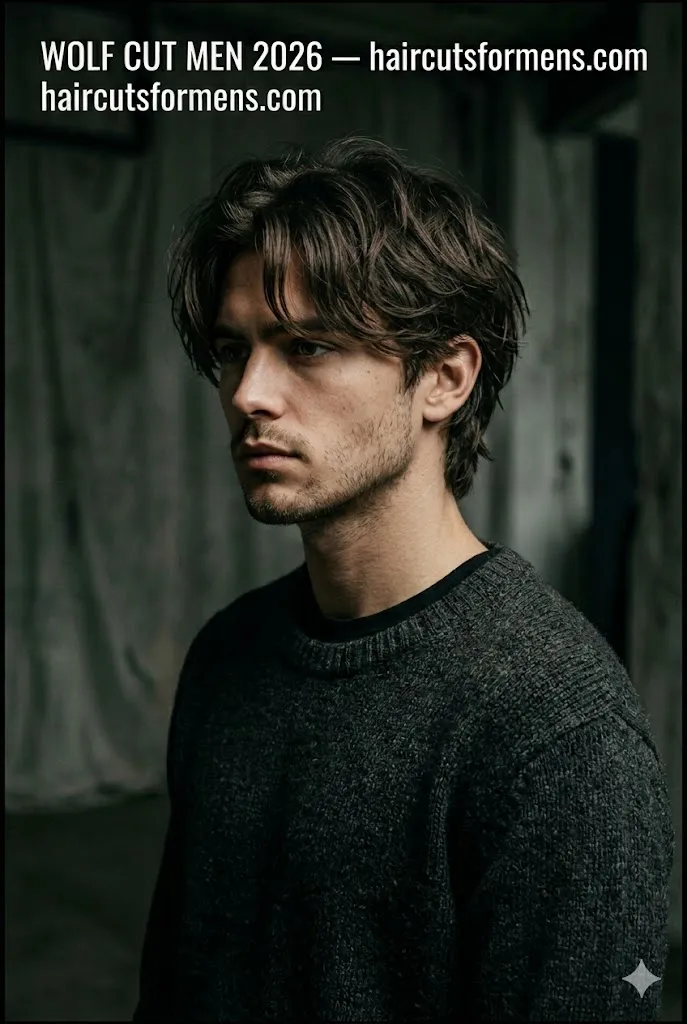
3. Long Wolf Cut Shoulder-approaching or shoulder-length layers with maximum flow. This is the wolf cut in its most dramatic form — best for men with wavy or curly hair who want a full, expressive look.
4. Wolf Cut with Curtain Bangs The most requested wolf cut variation. Curtain bangs are the signature front element — hair parted in the center, falling softly to each side of the forehead. They frame the face and are what most people picture when they think “wolf cut.”

5. Wolf Cut with No Bangs Not everyone suits or wants curtain bangs. A wolf cut can be worn with hair swept back from the face — the layers and texture do all the work without the fringe. A more mature, refined take on the style.
WOLF CUT WITH FADE VARIATIONS
6. Wolf Cut with Low Taper Fade Adding a low taper fade to the wolf cut cleans up the sides while keeping all the texture and length on top. This is the most barbershop-friendly version of the cut — it bridges the gap between a classic fade client and a wolf cut enthusiast.
Barber tip: “Wolf cut on top — layers and curtain bangs — with a low taper fade on the sides.”
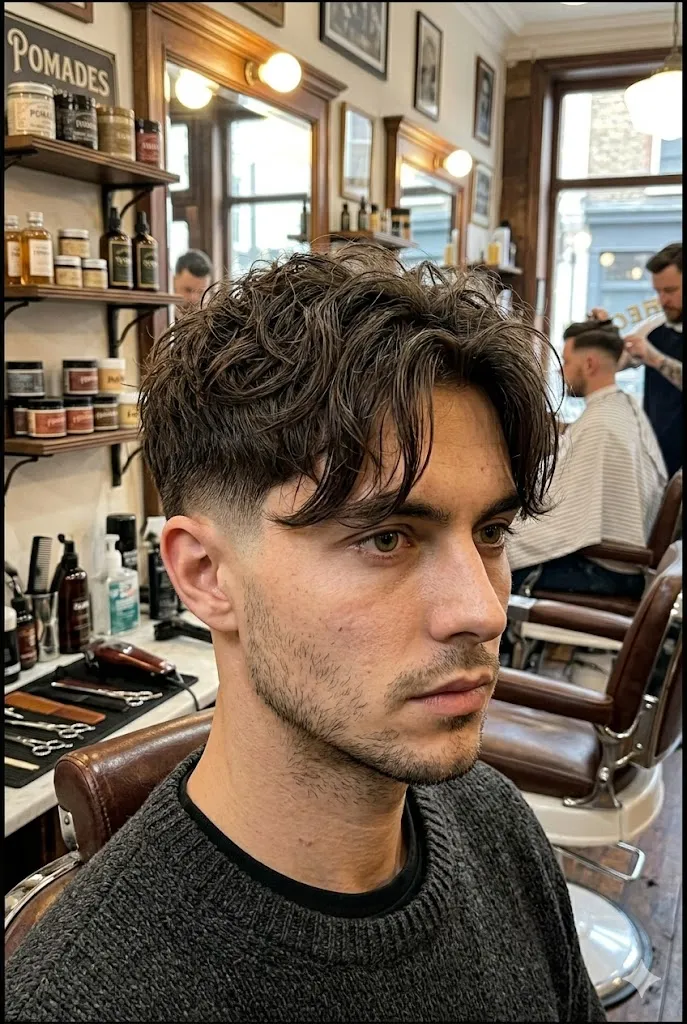
7. Wolf Cut with Mid Skin Fade A more dramatic version — the mid skin fade creates a bold contrast between the clean, sharp sides and the wild, layered top. Popular in 2026 for men who want the wolf cut energy with barbershop precision.
8. Wolf Cut with Undercut A disconnected undercut (shaved under the top layers) with a wolf cut on top creates a hidden contrast — the undercut is visible only when the hair moves or is pushed back. Edgy, fashion-forward, unique.
WOLF CUT BY HAIR TYPE
9. Wolf Cut — Wavy Hair Wavy hair is the wolf cut’s natural home. The waves amplify the layered texture, creating effortless volume and movement with minimal product. A light sea salt spray is all you need to enhance what’s already there.

10. Wolf Cut — Curly Hair Curly hair transforms the wolf cut into something spectacular. The curls fill out every layer with volume and personality. Key: ask your barber to cut dry or with the curl pattern. Keep heavy layering at the crown for maximum shape.
11. Wolf Cut — Straight Hair Straight hair requires more styling effort to achieve the wolf cut’s characteristic texture. The layers are still achievable, but you’ll need a diffuser, salt spray, or light wax to build texture. Worth the effort — straight-haired wolf cuts look sleek and intentional.
Styling tip for straight hair: Apply salt spray to damp hair, scrunch lightly, then diffuse on low heat. Finish with a tiny amount of matte wax worked through the ends.
12. Wolf Cut — Thick Hair Heavy layering is especially effective on thick hair — it removes bulk and creates movement where there was previously weight. A wolf cut on thick hair looks naturally full and expressive.
13. Wolf Cut — Fine Hair Fine hair can wear the wolf cut, but requires restraint. Ask for lighter layers (not too blunt or heavy) and use a volumizing mousse at the roots. Avoid heavy waxes or oils that weigh thin hair down.
STYLED WOLF CUT VARIATIONS
14. Slicked-Back Wolf Cut Push the layers back from the face with a light pomade for a more polished, intentional take on the wolf cut. The layers are still visible but the look is cleaner — great for semi-formal occasions.
15. Wolf Cut with Middle Part The middle part is the default for wolf cuts — and it’s having a major moment in 2026. A clean center part with curtain bangs falling symmetrically is the most classic expression of the style.
16. Wolf Cut with Side Part A side part gives the wolf cut a slightly more traditional, asymmetric look. Works particularly well for men who want the texture of a wolf cut but prefer a more structured front.
17. Textured Wolf Cut (No-Curl Look) For straight-haired men who want maximum texture without heat styling — work a small amount of sea salt paste or fiber paste through dry hair and scrunch. Creates a natural “lived-in” texture that mimics the effortlessness of wavy hair.
18. Wolf Cut Mullet Hybrid The line between wolf cut and mullet is blurring in 2026. A wolf cut with a more pronounced length difference between the front and the back leans into mullet territory — but keeps the layered, shaggy quality that makes a wolf cut a wolf cut.
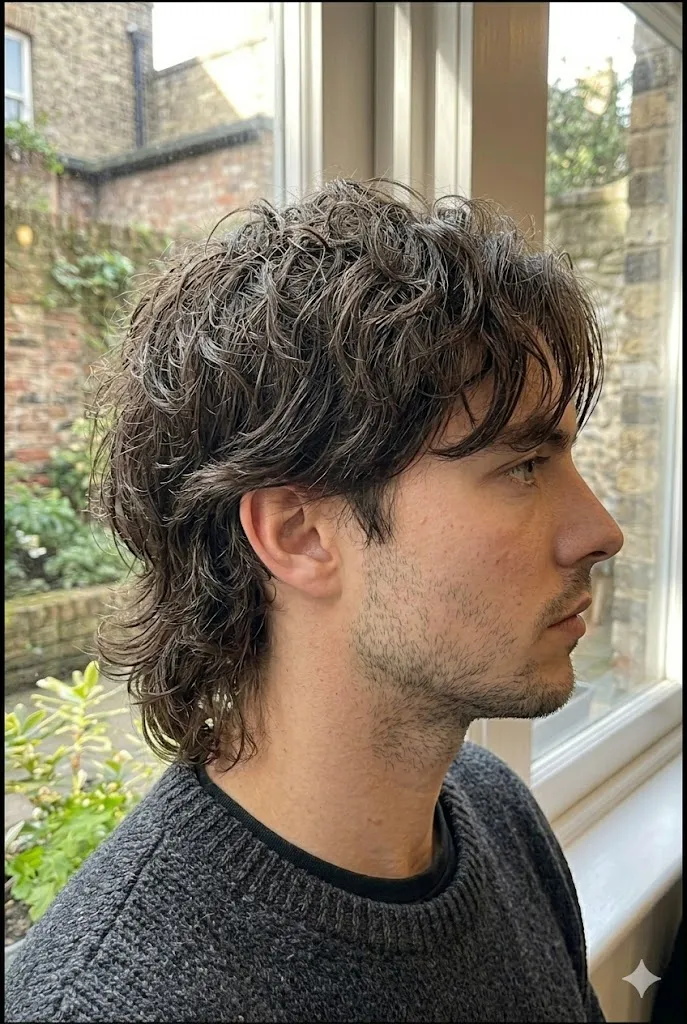
19. Wolf Cut for Older Men (30s, 40s) The wolf cut isn’t just for young men. A slightly shorter, more refined wolf cut — less extreme layers, softer curtain bangs — works beautifully for men in their 30s and 40s who want a modern, fashion-aware look without going too youthful.
20. Grow-Out Wolf Cut One of the best things about the wolf cut: it grows out beautifully. As the layers grow, the style softens and evolves naturally. If you’re currently growing your hair out, asking your barber to “tidy into a wolf cut shape” as you go is one of the most stylish ways to handle the process.
How to Style the Wolf Cut at Home
The wolf cut’s signature look is effortless — but it doesn’t happen on its own. Here’s the step-by-step:
For wavy or curly hair:
- Wash hair and towel-dry gently (don’t rough up the curl pattern)
- Apply a small amount of curl cream or mousse from roots to ends
- Scrunch hair upward to encourage waves and curls
- Air dry or diffuse on low heat
- Once dry, break up any crunchy texture with your fingers
For straight hair:
- Wash and towel-dry
- Apply sea salt spray evenly through damp hair
- Scrunch and tousle — don’t comb or brush
- Diffuse on medium heat, moving the diffuser around for volume
- Finish with a tiny amount of matte wax or fiber cream through the ends for texture
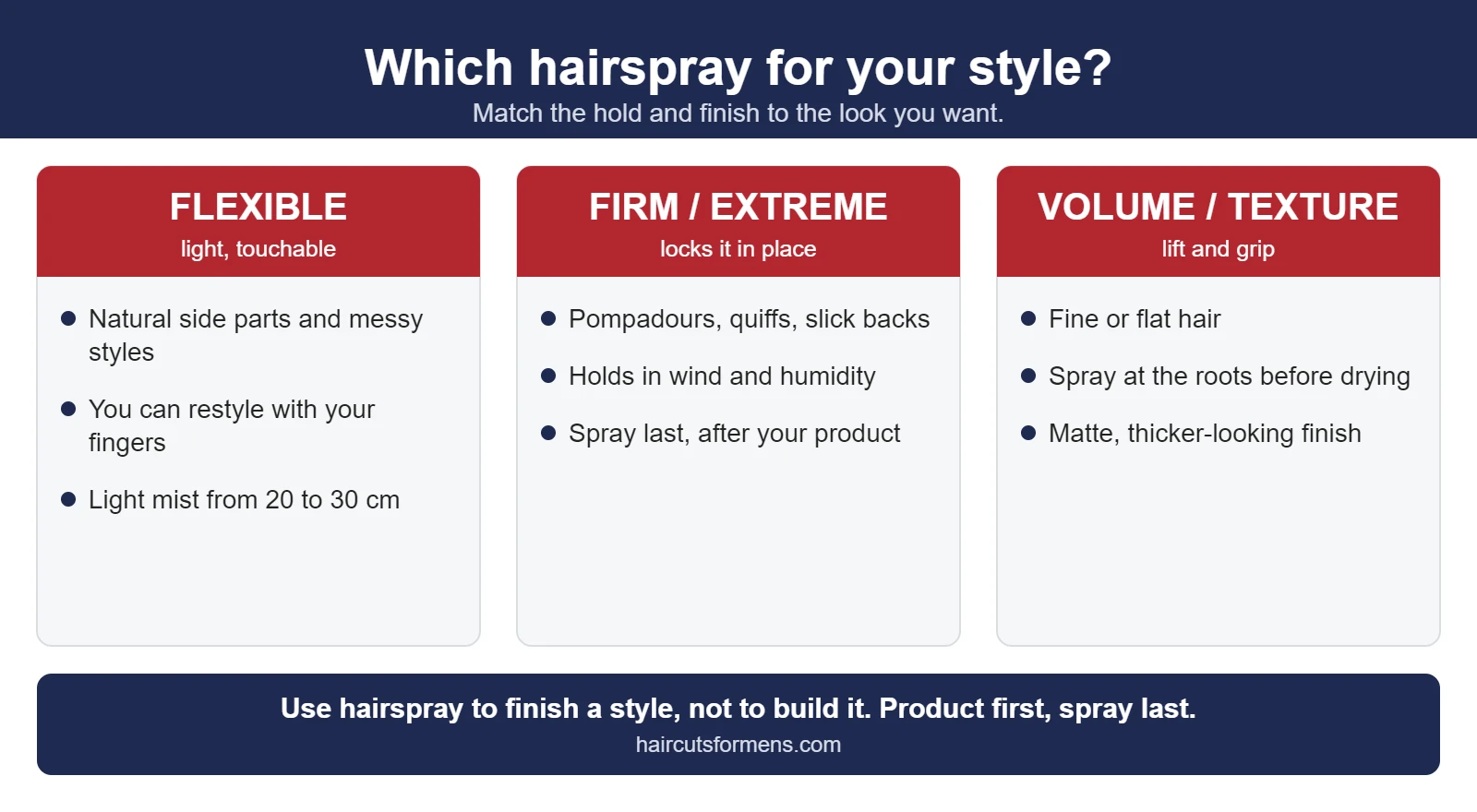
Products that work best with the wolf cut:
- Sea salt spray — the wolf cut’s best friend; creates natural texture and separation
- Curl cream — for wavy and curly hair; defines and moisturizes
- Matte wax or fiber paste — for straight hair; builds texture without shine
- Volumizing mousse — great for fine hair; lifts from the root
- Light pomade — for the slicked-back wolf cut variation
What to Tell Your Barber
The wolf cut can get lost in translation if you’re not specific. Here’s a reliable script:
“I’d like a wolf cut — can you do heavy layers throughout, shorter at the crown and longer toward the back. I want curtain bangs at the front — falling to each side. Keep it textured and a bit undone. [Optional: add a low taper fade on the sides.] My hair is [straight/wavy/curly] so I’d like the layers to work with that.”
Always bring a photo. The wolf cut has many interpretations — a clear reference image removes all ambiguity.
Frequently Asked Questions
What is a wolf cut for men? A wolf cut is a medium-to-long layered hairstyle that combines elements of the shag cut and the mullet. It features heavy layers, curtain bangs, and a tousled, textured finish. It’s designed to look effortlessly undone while still being intentionally styled.
Is the wolf cut still in style in 2026? Yes — the wolf cut remains one of the most popular men’s hairstyles in 2026. It has evolved from a viral TikTok trend into a mainstream barbershop staple, with more mature, refined variations becoming increasingly popular alongside the original.
Does the wolf cut work on straight hair? Yes, but it requires more styling effort. Use a sea salt spray, scrunch damp hair, and diffuse on low heat to build the texture that wavy and curly hair achieves naturally. The result is well worth the extra step.
How long does your hair need to be for a wolf cut? At minimum, around 3 inches on top to achieve the layered effect. The classic wolf cut works best with 4–6 inches of length. Shorter versions (2–3 inches) are possible but less dramatic.
How often should you get the wolf cut trimmed? Every 6–8 weeks is ideal. The wolf cut grows out beautifully — it doesn’t require frequent barbershop visits like a tight fade. Regular trims keep the layers and shape in check without resetting the look.
What’s the difference between a wolf cut and a shag cut? Both feature heavy layers and fringe, but the shag cut typically has more uniform layers throughout. The wolf cut has more volume and height at the crown and a more pronounced length difference from front to back — closer to a mullet silhouette.
Final Thoughts
The wolf cut is one of those rare hairstyles that feels genuinely free. It rewards your natural hair texture, grows out gracefully, works across a huge range of ages and styles, and — most importantly — looks like you weren’t trying too hard.
In 2026, there’s a wolf cut variation for every man. Find yours from this list, save your reference photo, and tell your barber exactly what you want. This is one trend that deserves to stay.